I took my lecture about the 20th Massachusetts on the road a few days ago and presented it to the Orange County Civil War Roundtable. I take a good deal of pride in delivering a worthwhile and engaging discussion, and I think Tuesday's episode was a solid effort. The audience seemed to really enjoy it and the syllabus that goes along with the verbiage from me again provided a strong sense of engagement and involvement for the listeners.
One of the highlights of this talk, and really any lecture I've ever delivered, is the Q/A at the end. Usually the queries spin into the subtext of the presentation and allow expansion on other themes, which is a blast. You get other perspectives and ideas, and since you don't prepare specifically for something you can't anticipate, it's a great mental exercise to mine your knowledge base on the spot for a cogent answer. I love that!
Showing posts with label Harvard Regiment. Show all posts
Showing posts with label Harvard Regiment. Show all posts
Friday, February 20, 2009

Monday, February 16, 2009
Civil War Multimedia: A Lost Cause Video, A Lecture, And The Blogosphere
Remember those questionnaires in junior high and high school that would help determine the "best way" you learn? I always thought those were junk, personally. A little viewing, some writing, a bit of listening, a good mixture was the key to a rich understanding of a subject. Thus I bring you the Civil War in three different media and three different themes.
First a furthering of the discussion of Civil War art that has been undertaken here and elsewhere. Cenantua's Blog and Civil War Memory brought me to this post at Vast Public Indifference, a blog I've followed for sometime, but had gotten a bit behind on. The video clip at the bottom is a fabulous juxtaposition and illustrates the fusion of Civil War art and the Lost Cause mythology.
I refer you to our previous discussions of Generals Lee and Jackson, and thus armed, you will see some striking imagery with a frankly bizarre, almost delusional grasp of the past in the song lyrics.
The overwritten commentary is like a breath of fresh air in a room that had the doors and windows closed for nearly 200 years (not a bad simile, if I do say so). This is a nice mix of reading, listening, and watching, so everyone is sure to get something out of it. Also, the unforgiving perspective she gives on the paintings and song lyrics is just right on the money.
But wait, you say you want to read more? Well then I provide you with a selection of new Civil War oriented blogs to choose from, and you can peruse to your heart's delight.
Draw The Sword: This is a fabulous blog maintained by Jenny Goellnitz focusing on Gettysburg monuments. What sets this blog apart is the "Find A Unit" function she has set up. See it for yourself. Fantastic!
This Mighty Scourge: A study of small units from brigade-level on down, also provides frequent posts "this day during the war" posts.
South From the North Woods: A blog by an Antietam park ranger and colleague of Mannie Gentile
Renegade South: A study of Southern Unionist sentiment by Victoria Bynum. An outstanding and diverse exploration of a challenging subject.
If you're sick of reading, and want to get back to a more auditory experience, well then just come out to Huntington Beach, CA tomorrow night and catch me delivering my lecture on the 20th Massachusetts Volunteer Infantry to the Orange County Civil War Roundtable. Same material as last August, but totally different audience, should be good fun.
First a furthering of the discussion of Civil War art that has been undertaken here and elsewhere. Cenantua's Blog and Civil War Memory brought me to this post at Vast Public Indifference, a blog I've followed for sometime, but had gotten a bit behind on. The video clip at the bottom is a fabulous juxtaposition and illustrates the fusion of Civil War art and the Lost Cause mythology.
I refer you to our previous discussions of Generals Lee and Jackson, and thus armed, you will see some striking imagery with a frankly bizarre, almost delusional grasp of the past in the song lyrics.
The overwritten commentary is like a breath of fresh air in a room that had the doors and windows closed for nearly 200 years (not a bad simile, if I do say so). This is a nice mix of reading, listening, and watching, so everyone is sure to get something out of it. Also, the unforgiving perspective she gives on the paintings and song lyrics is just right on the money.
But wait, you say you want to read more? Well then I provide you with a selection of new Civil War oriented blogs to choose from, and you can peruse to your heart's delight.
Draw The Sword: This is a fabulous blog maintained by Jenny Goellnitz focusing on Gettysburg monuments. What sets this blog apart is the "Find A Unit" function she has set up. See it for yourself. Fantastic!
This Mighty Scourge: A study of small units from brigade-level on down, also provides frequent posts "this day during the war" posts.
South From the North Woods: A blog by an Antietam park ranger and colleague of Mannie Gentile
Renegade South: A study of Southern Unionist sentiment by Victoria Bynum. An outstanding and diverse exploration of a challenging subject.
If you're sick of reading, and want to get back to a more auditory experience, well then just come out to Huntington Beach, CA tomorrow night and catch me delivering my lecture on the 20th Massachusetts Volunteer Infantry to the Orange County Civil War Roundtable. Same material as last August, but totally different audience, should be good fun.
Tuesday, November 11, 2008
Remembering Our Veterans With Accuracy And Respect: Why It's Time For A Moratorium On Civil War Combat Art
Today is the day that we remember our Veterans, and take a moment to give respect to their commitment and sacrifice. In this space, we consider how we have and continue to remember the American Civil War. Which brings us to the substance of this post, wherein I wish to again posit a criticism of the use of Civil War combat as a form of consumer art, especially when that work is given credit for "realism". I refer you please to my previous post on the subject where the work of Don Troiani, one of the most prolific ACW artists, was discussed.
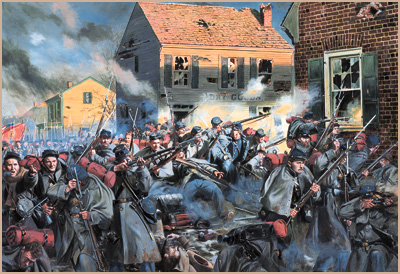
The utter lack of reality within this medium resurfaced during the recent book chat on "Harvard's Civil War" a text with Troiani's "Fire on Caroline Street" on the cover. I brought this issue up in the chat given we were discussing the 20th Massachusetts Regiment's experience at the Battle of Fredericksburg. I presented my take on the complete absence of trauma or blood and mentioned this glaring lack of accuracy and candor in Troiani's work. Several of the people in the chat mentioned how they'd never noticed that before.
Somehow in the 147 years since the Civil War, amidst the mythologizing and glorifying, we've forgotten what a brutal and gruesome experience this was for the men who fought it. At some point, the reality of Civil War combat has given way to something that is acceptable to hang on the wall of someone's home. We've neglected, or perhaps chosen to consciously ignore or subconsciously block out, the grim realities that faced soldiers and civilians on Civil War battlefields.
This type of treatment is not so widely seen with other American wars. For example, The Jess and I did a Google and EBay search for artwork about the Normandy landings on June 6, 1944. There is a minute commercial market for such work, which demonstrates that it isn't, and by extension shouldn't, be roundly accepted. Too many people remember exactly what happened that day, and our memories of it are too stark and raw to be dumbed down like that.
So how come this sort of art is acceptable with regards to the Civil War? These paintings, and many others, are praised for their accuracy and bought and sold as commodities. They depict famous battle moments, to be sure, but the most salient point is that men, in the moments that are so memorable, also bled, suffered, and died on those spots. I do not believe the best way to remember what happened there is through this type of sanitized glorification of something truly awful.
The citizenry during the war, especially after the Battle of Shiloh, knew exactly what was happening. They were the first citizens to see the brutal reality of war through the camera lens, and communities were flooded with the wounded, and cemeteries filled with the dead. There were of course contemporary artist renderings of Civil War fighting, most from journalists and troops who witnessed fighting. This art, while certainly not as refined as Mr. Troiani's, pulled no punches when it came to showing destruction and death. You may be sure these depictions weren't getting slapped up on the walls of private homes.
There was no hiding from the realities of war in 1861-1865, and the Civil War should have been a seminal event in the way we think about war, one that would hopefully discourage us from ever wanting to see another. Somehow, this didn't happen. There is indeed a disconnect between the way we choose to think about Civil War combat and what actually transpired, and it is fed by this sort of pulp art that is only selectively correct and maximally palatable, but certainly not reality.
We have a responsibility to remember what soldiers in our wars have done, and we must emphasize the requirement that we do this honestly. It is not only inaccurate, but dishonest to continue to present Civil War combat in the way that we have become used to. To help cement my point, I give you some words from Mr. Troiani himself, quoted from www.historicalartprints.com:
"If an historical painting is not reasonably accurate, then it's worthless both as art and as a historical document," Troiani declares. "If you are going to become involved in this field then there is little excuse for a pattern of inaccuracies."
Couldn't have said it better myself.
The utter lack of reality within this medium resurfaced during the recent book chat on "Harvard's Civil War" a text with Troiani's "Fire on Caroline Street" on the cover. I brought this issue up in the chat given we were discussing the 20th Massachusetts Regiment's experience at the Battle of Fredericksburg. I presented my take on the complete absence of trauma or blood and mentioned this glaring lack of accuracy and candor in Troiani's work. Several of the people in the chat mentioned how they'd never noticed that before.
Somehow in the 147 years since the Civil War, amidst the mythologizing and glorifying, we've forgotten what a brutal and gruesome experience this was for the men who fought it. At some point, the reality of Civil War combat has given way to something that is acceptable to hang on the wall of someone's home. We've neglected, or perhaps chosen to consciously ignore or subconsciously block out, the grim realities that faced soldiers and civilians on Civil War battlefields.
This type of treatment is not so widely seen with other American wars. For example, The Jess and I did a Google and EBay search for artwork about the Normandy landings on June 6, 1944. There is a minute commercial market for such work, which demonstrates that it isn't, and by extension shouldn't, be roundly accepted. Too many people remember exactly what happened that day, and our memories of it are too stark and raw to be dumbed down like that.
So how come this sort of art is acceptable with regards to the Civil War? These paintings, and many others, are praised for their accuracy and bought and sold as commodities. They depict famous battle moments, to be sure, but the most salient point is that men, in the moments that are so memorable, also bled, suffered, and died on those spots. I do not believe the best way to remember what happened there is through this type of sanitized glorification of something truly awful.
The citizenry during the war, especially after the Battle of Shiloh, knew exactly what was happening. They were the first citizens to see the brutal reality of war through the camera lens, and communities were flooded with the wounded, and cemeteries filled with the dead. There were of course contemporary artist renderings of Civil War fighting, most from journalists and troops who witnessed fighting. This art, while certainly not as refined as Mr. Troiani's, pulled no punches when it came to showing destruction and death. You may be sure these depictions weren't getting slapped up on the walls of private homes.
There was no hiding from the realities of war in 1861-1865, and the Civil War should have been a seminal event in the way we think about war, one that would hopefully discourage us from ever wanting to see another. Somehow, this didn't happen. There is indeed a disconnect between the way we choose to think about Civil War combat and what actually transpired, and it is fed by this sort of pulp art that is only selectively correct and maximally palatable, but certainly not reality.
We have a responsibility to remember what soldiers in our wars have done, and we must emphasize the requirement that we do this honestly. It is not only inaccurate, but dishonest to continue to present Civil War combat in the way that we have become used to. To help cement my point, I give you some words from Mr. Troiani himself, quoted from www.historicalartprints.com:
"If an historical painting is not reasonably accurate, then it's worthless both as art and as a historical document," Troiani declares. "If you are going to become involved in this field then there is little excuse for a pattern of inaccuracies."
Couldn't have said it better myself.
Friday, October 31, 2008
Housekeeping And Some Great Blogs
As I have received some much-appreciated attention from a few esteemed fellow bloggers, I am excited to return the favor in kind. I thoroughly enjoy being a part of this community, and take great pride in being able to recognize stellar work as I come across it.
I direct you first, please, to a blog called Wig-Wags. This work is presented by Rene Tyree, a grad student at American Military University who is focusing on the Civil War. I love what I do for a living and loved my graduate education, but that does sound like fun. Anyway, if you want a comprehensive walk through the causes of the war among a host of other choices, not the least of which are the stellar book reviews, then you must turn here.
For a plentitude of book reviews (he's reading Glatthaar's "Everyman's War"), and news stories, get to Civil War Librarian.
Jim Beeghley (now Dr. Jim Beeghley, well done) runs a blog called Teaching The Civil War With Technology. This sort of effort is going to be a cornerstone in helping focus people's interests in learning about the war, disseminating information, and furthering research. Spend some time looking at the picture in the title bar, I love it! The Google Time Line Feature is pretty sweet, too.
Other bits and pieces...
-I may be able to deliver my lecture on the 20th Massachusetts Regiment at Gettysburg two more time next year; to the Orange County Roundtable and the Inland Empire Roundtable. I'm very excited about these opportunities, just need to get the dates to jibe.
-The Civil War Network is unfortunately down due to equipment issues, but fortunately not out. Can't wait for it to get back online
-This Sunday is chapters 7-8 of Miller's "Harvard's Civil War" at Civil War Interactive's book chat. It's an amazing book, and a cornerstone of research for my aforementioned lecture, and the conversation has been quite lively. It's free to participate.
-I've read and posted all of the comments that have been coming in, thanks and keep 'em coming!
I direct you first, please, to a blog called Wig-Wags. This work is presented by Rene Tyree, a grad student at American Military University who is focusing on the Civil War. I love what I do for a living and loved my graduate education, but that does sound like fun. Anyway, if you want a comprehensive walk through the causes of the war among a host of other choices, not the least of which are the stellar book reviews, then you must turn here.
For a plentitude of book reviews (he's reading Glatthaar's "Everyman's War"), and news stories, get to Civil War Librarian.
Jim Beeghley (now Dr. Jim Beeghley, well done) runs a blog called Teaching The Civil War With Technology. This sort of effort is going to be a cornerstone in helping focus people's interests in learning about the war, disseminating information, and furthering research. Spend some time looking at the picture in the title bar, I love it! The Google Time Line Feature is pretty sweet, too.
Other bits and pieces...
-I may be able to deliver my lecture on the 20th Massachusetts Regiment at Gettysburg two more time next year; to the Orange County Roundtable and the Inland Empire Roundtable. I'm very excited about these opportunities, just need to get the dates to jibe.
-The Civil War Network is unfortunately down due to equipment issues, but fortunately not out. Can't wait for it to get back online
-This Sunday is chapters 7-8 of Miller's "Harvard's Civil War" at Civil War Interactive's book chat. It's an amazing book, and a cornerstone of research for my aforementioned lecture, and the conversation has been quite lively. It's free to participate.
-I've read and posted all of the comments that have been coming in, thanks and keep 'em coming!
Thursday, October 16, 2008
Lecture on the 20th Massachusetts Infantry Regiment A Great Success!
I delivered my lecture last night to the members of the San Diego Civil War Roundtable entitled "Revenge and Redemption: The 20th Massachusetts Infantry Regiment at Gettysburg" and am very proud to say it was a big success!
The talk came in at just about 45 minutes and, based upon feedback I got during the Q and A as well as afterwards, was very well received. We spent a few minutes discussing the origins of the regiment and some of the personalities in it, before moving onto the 20th in the war in the East. We hit Ball's Bluff, Yorktown, the Seven Days, Antietam, Fredericksburg, and Second Fredericksburg. In proceeding this way, we were able to lay a good foundation for the regiment's trials and tribulations before Gettysburg.
The bulk of the talk was on the regiment at Gettysburg, and I found some wonderful quotes and personalities to discuss that really brought the experience to life, both for me and my audience. I could hear groans, signs, and the occasional "Wow" as we moved through the subject matter. We finished by traveling with the 20th through the rest of the war, then visited the regimental memorial on Cemetery Ridge at Gettysburg.
One of the best parts of the talk happened quite serendipitously, but I will use again the next time I give it. I had 42 slides, a mixture of photographs, book covers, and maps, as part of a Powerpoint show to be used as an adjunct to my ever-melodious and commanding basso profundo voice. Turned out that our projector would not be available, so I converted the slides into a syllabus and made 10 copies.
There was one syllabus, unbound, for everyone 2-3 people to share, and I would mention when they should turn the page. This was a wonderful way for the presentation to move on. People didn't look ahead, so there was always a measure of suspense, the picture quality was excellent, so the images really had an impact, and the lights stayed on, so no one got drowsy.
The best part was, it gave the room a very special kinetic energy, an interactive dynamism as people could really sink into the subject matter. I saw people pointing and discussing, as well as just staring at some of the faces and images before them. Definitely a fantastic way to have the talk go forward.
Up at the dias, I had an absolute ball, and loved speaking before a group of friends, peers, and The Jess about a subject I'm quite passionate about. I'm glad it showed through and was truly flattered by the compliments I received.
I cannot wait to give the lecture again and would be more than happy to go to other roundtables, classrooms, book clubs, etc. If you'd be interested in hearing the talk, please let me know in a comment.
Speaking of book clubs, the book chat at Civil War Interactive is doing "Harvard's Civil War" by Richard Miller. This is the best regimental history I've ever read and gives an amazing discussion of the 20th before, during, and after the war. It's free to participate, so please sign up!
The talk came in at just about 45 minutes and, based upon feedback I got during the Q and A as well as afterwards, was very well received. We spent a few minutes discussing the origins of the regiment and some of the personalities in it, before moving onto the 20th in the war in the East. We hit Ball's Bluff, Yorktown, the Seven Days, Antietam, Fredericksburg, and Second Fredericksburg. In proceeding this way, we were able to lay a good foundation for the regiment's trials and tribulations before Gettysburg.
The bulk of the talk was on the regiment at Gettysburg, and I found some wonderful quotes and personalities to discuss that really brought the experience to life, both for me and my audience. I could hear groans, signs, and the occasional "Wow" as we moved through the subject matter. We finished by traveling with the 20th through the rest of the war, then visited the regimental memorial on Cemetery Ridge at Gettysburg.
One of the best parts of the talk happened quite serendipitously, but I will use again the next time I give it. I had 42 slides, a mixture of photographs, book covers, and maps, as part of a Powerpoint show to be used as an adjunct to my ever-melodious and commanding basso profundo voice. Turned out that our projector would not be available, so I converted the slides into a syllabus and made 10 copies.
There was one syllabus, unbound, for everyone 2-3 people to share, and I would mention when they should turn the page. This was a wonderful way for the presentation to move on. People didn't look ahead, so there was always a measure of suspense, the picture quality was excellent, so the images really had an impact, and the lights stayed on, so no one got drowsy.
The best part was, it gave the room a very special kinetic energy, an interactive dynamism as people could really sink into the subject matter. I saw people pointing and discussing, as well as just staring at some of the faces and images before them. Definitely a fantastic way to have the talk go forward.
Up at the dias, I had an absolute ball, and loved speaking before a group of friends, peers, and The Jess about a subject I'm quite passionate about. I'm glad it showed through and was truly flattered by the compliments I received.
I cannot wait to give the lecture again and would be more than happy to go to other roundtables, classrooms, book clubs, etc. If you'd be interested in hearing the talk, please let me know in a comment.
Speaking of book clubs, the book chat at Civil War Interactive is doing "Harvard's Civil War" by Richard Miller. This is the best regimental history I've ever read and gives an amazing discussion of the 20th before, during, and after the war. It's free to participate, so please sign up!
Wednesday, October 15, 2008
My Lecture On The 20th Massachusetts Infantry At Gettysburg Tonight!
Just a quick post today as I need to finish preparing to deliver my lecture tonight to the San Diego Civil War Roundtable. I've given it the title of "Revenge and Redemption: The 20th Massachusetts Infantry Regiment at Gettysburg." It's been an absolute blast reconnecting with the themes, people, and events that I last studied in detail a decade ago as a UCLA undergrad, and I hope that my interest and enthusiasm is reflected tonight.
It should be around 45 minutes and, though I'd hoped to have a projector available for images, I'm going to be using a handout instead. I actually think this may work better, as long as people don't skip ahead in the syllabus. There's some great carte de visite's, maps, and art that we'll be looking at, and the content, well, you've gotta hear it to believe what the men of the Harvard Regiment actually went through during their term of service and especially at Gettysburg.
I'm really excited to be speaking in public again, it's been awhile and it's something that I really enjoy doing. The meeting is open to the public and free, so if you're in San Diego and looking for something to do, feel free to join us. I provide here a link to the San Diego Civil War Roundtable website that has the address of our meeting place.
It should be around 45 minutes and, though I'd hoped to have a projector available for images, I'm going to be using a handout instead. I actually think this may work better, as long as people don't skip ahead in the syllabus. There's some great carte de visite's, maps, and art that we'll be looking at, and the content, well, you've gotta hear it to believe what the men of the Harvard Regiment actually went through during their term of service and especially at Gettysburg.
I'm really excited to be speaking in public again, it's been awhile and it's something that I really enjoy doing. The meeting is open to the public and free, so if you're in San Diego and looking for something to do, feel free to join us. I provide here a link to the San Diego Civil War Roundtable website that has the address of our meeting place.
Tuesday, October 7, 2008
San Diego Civil War Roundtable Newsletter "Skirmish Line" Now Available
The October issue of "Skirmish Line", the newsletter for the San Diego Civil War Roundtable, is now available online. There's a brief piece about the 20th Massachusetts and my lecture next week. The way to access it is to click on the link above, then select "2008" under year, then "October" under month; it'll load as a pdf file. Take a look at the flag (which will reappear in my talk) and note just how many battle sites are embroidered!
Sunday, October 5, 2008
Time To Focus On The 20th Massachusetts Infantry AKA The Harvard Regiment
Ever since my senior year at UCLA, when I had the opportunity to take a class with Dr. Joan Waugh wherein each student selected a Civil War regiment as the subject of a rigorous study and paper, I have had a strong bond with the 20th Massachusetts Infantry Regiment; more famously known as The Harvard Regiment. This moniker was assigned because 31 of the officers and men of the regiment were either active students or recent graduates when they joined the regiment to fight.
This was by far my favorite undergrad class, and that affinity has persisted. I've been able to collect some of the seminal texts regarding the 20th over the years, and was thrilled when Richard Miller published "Harvard's Civil War", which is the best regimental history I've ever read. This interest has reached new levels over the past few months because of three wonderful happenings.
First, I was invited to join a community on Yahoo focusing on the 20th. Every Tuesday we have an online chat, there's a daily digest that comes out, and an active homepage on Yahoo for people to share photos, blogs, etc.
The man who runs this community is behind the second part of this renaissance, as he got the good people at Civil War Interactive to select "Harvard's Civil War" as the next subject of the website's book chat. Here is the schedule if you would like to participate.
The last part of this focus is actually a two-parter. I am in the midst of preparation for my lecture on October 15th for the San Diego Civil War Roundtable where I will be discussing the 20th at the Battle of Gettysburg. This is an absolute blast, as I feel like I'm getting back to my Civil War roots, and have nearly every book I need already in my collection. It's also my love of books that is the second part of this new focus. The one book I wanted to use, entitled "Isn't It Glorious", is coming in the mail this week. I got to speak with the publisher at Moon Trail Books over the phone and I was stoked when she asked me to please review the book and that she would send me a review copy along with my purchase. What an honor and what a thrill!
This was by far my favorite undergrad class, and that affinity has persisted. I've been able to collect some of the seminal texts regarding the 20th over the years, and was thrilled when Richard Miller published "Harvard's Civil War", which is the best regimental history I've ever read. This interest has reached new levels over the past few months because of three wonderful happenings.
First, I was invited to join a community on Yahoo focusing on the 20th. Every Tuesday we have an online chat, there's a daily digest that comes out, and an active homepage on Yahoo for people to share photos, blogs, etc.
The man who runs this community is behind the second part of this renaissance, as he got the good people at Civil War Interactive to select "Harvard's Civil War" as the next subject of the website's book chat. Here is the schedule if you would like to participate.
The last part of this focus is actually a two-parter. I am in the midst of preparation for my lecture on October 15th for the San Diego Civil War Roundtable where I will be discussing the 20th at the Battle of Gettysburg. This is an absolute blast, as I feel like I'm getting back to my Civil War roots, and have nearly every book I need already in my collection. It's also my love of books that is the second part of this new focus. The one book I wanted to use, entitled "Isn't It Glorious", is coming in the mail this week. I got to speak with the publisher at Moon Trail Books over the phone and I was stoked when she asked me to please review the book and that she would send me a review copy along with my purchase. What an honor and what a thrill!
Wednesday, July 16, 2008
San Diego Civil War Roundtable
Being that tonight is the third Wednesday of the month, it is a big night for myself and my fellow San Diego Civil War aficionados, for this is the time when the San Diego Civil War Roundtable convenes.
So let's bust up a few stereotypes right here, right now
-no, we do not all dress up like Union or Confederate soldiers
-no, I am not a Civil War reenactor
-no, we do not whistle Dixie
-no, there is no campfire
-no, we are not trying to glorify the Confederacy (or the Union, for that matter)
The group functions as a resource for people interested in discussing and learning about the Civil War through a monthly lecture series. Each meeting covers a specific topic selected by the person giving the talk that night. We usually start with updates on local lectures and interesting book publications. There is also a great opportunity for bibliophiles to augment their collections as the stash of used Civil War books for sale is never-ending. The cause is also noteworthy, as all proceeds go towards battlefield preservation.
Once we've all spent a few bucks, we get started with the subject at hand. Over the past 1.5 years I've been a member, there have been lectures on topics ranging from Jefferson Davis and the Pope to infectious disease during the war. We've had authors discussing their books, battlefield guides covering their experiences, all sorts of fantastic authorities.
Tonight, we'll be hearing a group member who is an expert at geneology discussing the path he took to find the war records of a relative in Michigan. This is a fascinating topic and one that is broadly applicable; most people, including myself, have relatives that fought in the war whether you know about it or not.
October will be my opportunity to take the podium for a lecture on the Harvard Regiment and its service during the Battle of Gettysburg. This is going to be a great opportunity to discuss this band of warriors in a single campaign without all of the myth-making and glorification that usually accompanies regimental discussions. I'll be sure to post more about it closer to the time, right now the talk is very much in the formative stages.
Anyway, the SDCWRT website has directions as well as a link to the monthly newsletter if you wanna check it out. The meetings are free and there is no expectation of any Civil War knowledge or background, thus the material is readily accessible to anyone with a hint of interest. It's a unique experience in a really relaxed environment, so join me if you're so inclined
So let's bust up a few stereotypes right here, right now
-no, we do not all dress up like Union or Confederate soldiers
-no, I am not a Civil War reenactor
-no, we do not whistle Dixie
-no, there is no campfire
-no, we are not trying to glorify the Confederacy (or the Union, for that matter)
The group functions as a resource for people interested in discussing and learning about the Civil War through a monthly lecture series. Each meeting covers a specific topic selected by the person giving the talk that night. We usually start with updates on local lectures and interesting book publications. There is also a great opportunity for bibliophiles to augment their collections as the stash of used Civil War books for sale is never-ending. The cause is also noteworthy, as all proceeds go towards battlefield preservation.
Once we've all spent a few bucks, we get started with the subject at hand. Over the past 1.5 years I've been a member, there have been lectures on topics ranging from Jefferson Davis and the Pope to infectious disease during the war. We've had authors discussing their books, battlefield guides covering their experiences, all sorts of fantastic authorities.
Tonight, we'll be hearing a group member who is an expert at geneology discussing the path he took to find the war records of a relative in Michigan. This is a fascinating topic and one that is broadly applicable; most people, including myself, have relatives that fought in the war whether you know about it or not.
October will be my opportunity to take the podium for a lecture on the Harvard Regiment and its service during the Battle of Gettysburg. This is going to be a great opportunity to discuss this band of warriors in a single campaign without all of the myth-making and glorification that usually accompanies regimental discussions. I'll be sure to post more about it closer to the time, right now the talk is very much in the formative stages.
Anyway, the SDCWRT website has directions as well as a link to the monthly newsletter if you wanna check it out. The meetings are free and there is no expectation of any Civil War knowledge or background, thus the material is readily accessible to anyone with a hint of interest. It's a unique experience in a really relaxed environment, so join me if you're so inclined
Thursday, July 3, 2008
Why Gettysburg Still And Always Matters
The battlefield charge is a unique moment in military history; often tragic and bloody, these times when brave men rush into the face of enemy guns quickly become the stuff of myth and legend (the Charge of the Light Brigade, Henry V's "once more into the breach, dear friends) There is a long list of famous battlefield charges in military history, and 145 years ago, the American contribution was made on the field between Seminary Ridge and Cemetery Ridge at Gettysburg.
After eyeing each other across No Man's Land all morning, and hunkering under a multi-hundred gun artillery barrage that could be heard for miles in every direction, the two armies again came to grips in a desperate and doomed assault forever known as Pickett's Charge.
After a day of tremendous victory, followed by a day of frustrated assaults on both Union flanks, General Robert E. Lee was anxious to thrust a large force against the Union center on the third day of fighting in an attempt to break their lines and drive the Army of the Potomac from the field. This massive task fell to three division from the Confederate I Corps and III Corps, none more famous than that of General George Pickett.
The task of these roughly 12,500 men was a tall one, as they would have to cross 3/4 of mile of open field, taking front and flank fire the whole way, then charge right into the muzzles of the Union troops at the center of the line, troops that were ready and waiting.
The Union commander, General George Meade, had been especially prescient the night before and, at the conclusion of a council of war on the night of July 2, he took Gen. John Gibbon aside. Gibbon's forces would be defending the central portion of the Union line the next morning, and Meade told him that his troops should make ready, as they would bear the brunt of the next day's Confederate assault. Low stone walls were fashioned, rifles were loaded and stacked in easy reach, and artillery was brought forward.
To Lee, this assault seemed the grand culmination of this tremendous battle, but to General James Longstreet, his chief advisor, it was clearly a disaster in the making. Lee would have none of it; however, and the assault went off as planned.
And, as expected, was crushed under the weight of Union metal and courage.
Of the roughly 12,500 men who rushed Cemetery Ridge, more than 50% were either killed, wounded, or captured in less than one hour of fighting. The attack did punch through the Union line in two places, most famously near the Copse of Trees, but both breaches were quickly sealed by reinforcements (including a regiment near and dear to my heart, the 20th Massachusetts).
As the Confederates straggled back to their lines, it was clear that a tremendous victory had been won by the Army of the Potomac, and Lee, desperate to rally his soldiers, was heard to tell several that "this was all my fault". When Lee came to General Pickett, who had survived the charge by hunkering down at the Codori Farm away from the frontline, and asked him to rally his division, Pickett reportedly replied "General Lee, I have no division."
The two armies would again stare at each other across a bloody field for more than a day. Then, on the 5th of July, 1863, General Lee and his Army of Northern Virginia would retire the field and begin the long retreat back to Virginia.
For the Union army and the North, this was a huge victory, made even greater by the capture of Vicksburg by Union forces under General Ulysses Grant on the 4th of July. These two victories were monumental boosts to the North and equally shattering blows to the Confederacy.
In the final accounting, there were somewhere between 45-51,000 casualties in the three days of fighting at Gettysburg. This was a fight that forever seared itself into the national consciousness and remains of particular interest of both scholars and tourists alike.
For me, there are several reasons why Gettysburg is and will likely always be of particular interest. One is the idea of Gettysburg as myth and part of our collective memory. As an adjunct to my study of 19th century America as part of my history degree at UCLA, I also studied ancient Greek history, and there is a wonderful connection between the two through this battle.
Another reason is that this is the only battlefield I've visited, walked, and sifted between my fingers. It's one thing to read about a battle, it's something altogether different to stare at the landmarks and walk the ground. Poignant and heartwrenching hardly begin to describe it.
In my course of study at UCLA, I worked with an amazing professor, Dr. Joan Waugh, who taught 5 of my classes. As a senior, I was in a seminar called "The Soldier's Experience in the Civil War" and as a final project, each student was to study a certain regiment. I adopted the 20th Massachusetts, and several months and many tens of pages later, I had drafted my paper. This regiment, known as the Harvard Regiment, stood its ground during Pickett's Charge and helped win the day. There is an amazing monument to the Harvard Regiment on Cemetery Ridge just south of the Copse of Trees, and to stand there on a warm day and think about the men I had studied; what they believed, why they fought, how they suffered and died brought tears to my eyes.
The final reason is that The Jess came with me on that trip. We had only been dating for a few months, and the trip had been planned even before we met. I asked her if she wanted to come with, not sure what response to expect. Not only did she book a ticket, but she started pulling books off my shelves and reading about the battle in preparation. There are few people who know as much about General John Reynolds as my wife, and we had an amazing time sharing the experience together. I was blown away by her shared enthusiasm for something I was so passionate about.
Best of all, I realized during our trip to Gettysburg that I was in love with her.
After eyeing each other across No Man's Land all morning, and hunkering under a multi-hundred gun artillery barrage that could be heard for miles in every direction, the two armies again came to grips in a desperate and doomed assault forever known as Pickett's Charge.
After a day of tremendous victory, followed by a day of frustrated assaults on both Union flanks, General Robert E. Lee was anxious to thrust a large force against the Union center on the third day of fighting in an attempt to break their lines and drive the Army of the Potomac from the field. This massive task fell to three division from the Confederate I Corps and III Corps, none more famous than that of General George Pickett.
The task of these roughly 12,500 men was a tall one, as they would have to cross 3/4 of mile of open field, taking front and flank fire the whole way, then charge right into the muzzles of the Union troops at the center of the line, troops that were ready and waiting.
The Union commander, General George Meade, had been especially prescient the night before and, at the conclusion of a council of war on the night of July 2, he took Gen. John Gibbon aside. Gibbon's forces would be defending the central portion of the Union line the next morning, and Meade told him that his troops should make ready, as they would bear the brunt of the next day's Confederate assault. Low stone walls were fashioned, rifles were loaded and stacked in easy reach, and artillery was brought forward.
To Lee, this assault seemed the grand culmination of this tremendous battle, but to General James Longstreet, his chief advisor, it was clearly a disaster in the making. Lee would have none of it; however, and the assault went off as planned.
And, as expected, was crushed under the weight of Union metal and courage.
Of the roughly 12,500 men who rushed Cemetery Ridge, more than 50% were either killed, wounded, or captured in less than one hour of fighting. The attack did punch through the Union line in two places, most famously near the Copse of Trees, but both breaches were quickly sealed by reinforcements (including a regiment near and dear to my heart, the 20th Massachusetts).
As the Confederates straggled back to their lines, it was clear that a tremendous victory had been won by the Army of the Potomac, and Lee, desperate to rally his soldiers, was heard to tell several that "this was all my fault". When Lee came to General Pickett, who had survived the charge by hunkering down at the Codori Farm away from the frontline, and asked him to rally his division, Pickett reportedly replied "General Lee, I have no division."
The two armies would again stare at each other across a bloody field for more than a day. Then, on the 5th of July, 1863, General Lee and his Army of Northern Virginia would retire the field and begin the long retreat back to Virginia.
For the Union army and the North, this was a huge victory, made even greater by the capture of Vicksburg by Union forces under General Ulysses Grant on the 4th of July. These two victories were monumental boosts to the North and equally shattering blows to the Confederacy.
In the final accounting, there were somewhere between 45-51,000 casualties in the three days of fighting at Gettysburg. This was a fight that forever seared itself into the national consciousness and remains of particular interest of both scholars and tourists alike.
For me, there are several reasons why Gettysburg is and will likely always be of particular interest. One is the idea of Gettysburg as myth and part of our collective memory. As an adjunct to my study of 19th century America as part of my history degree at UCLA, I also studied ancient Greek history, and there is a wonderful connection between the two through this battle.
Another reason is that this is the only battlefield I've visited, walked, and sifted between my fingers. It's one thing to read about a battle, it's something altogether different to stare at the landmarks and walk the ground. Poignant and heartwrenching hardly begin to describe it.
In my course of study at UCLA, I worked with an amazing professor, Dr. Joan Waugh, who taught 5 of my classes. As a senior, I was in a seminar called "The Soldier's Experience in the Civil War" and as a final project, each student was to study a certain regiment. I adopted the 20th Massachusetts, and several months and many tens of pages later, I had drafted my paper. This regiment, known as the Harvard Regiment, stood its ground during Pickett's Charge and helped win the day. There is an amazing monument to the Harvard Regiment on Cemetery Ridge just south of the Copse of Trees, and to stand there on a warm day and think about the men I had studied; what they believed, why they fought, how they suffered and died brought tears to my eyes.
The final reason is that The Jess came with me on that trip. We had only been dating for a few months, and the trip had been planned even before we met. I asked her if she wanted to come with, not sure what response to expect. Not only did she book a ticket, but she started pulling books off my shelves and reading about the battle in preparation. There are few people who know as much about General John Reynolds as my wife, and we had an amazing time sharing the experience together. I was blown away by her shared enthusiasm for something I was so passionate about.
Best of all, I realized during our trip to Gettysburg that I was in love with her.
Subscribe to:
Posts (Atom)


 Posts
Posts