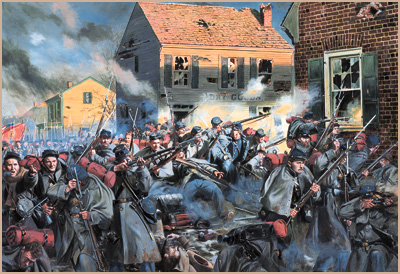
Today is the day that we remember our Veterans, and take a moment to give respect to their commitment and sacrifice. In this space, we consider how we have and continue to remember the American Civil War. Which brings us to the substance of this post, wherein I wish to again posit a criticism of the use of Civil War combat as a form of consumer art, especially when that work is given credit for "realism". I refer you please to my previous post on the subject where the work of Don Troiani, one of the most prolific ACW artists, was discussed.
The utter lack of reality within this medium resurfaced during the recent book chat on "Harvard's Civil War" a text with Troiani's "Fire on Caroline Street" on the cover. I brought this issue up in the chat given we were discussing the 20th Massachusetts Regiment's experience at the Battle of Fredericksburg. I presented my take on the complete absence of trauma or blood and mentioned this glaring lack of accuracy and candor in Troiani's work. Several of the people in the chat mentioned how they'd never noticed that before.
Somehow in the 147 years since the Civil War, amidst the mythologizing and glorifying, we've forgotten what a brutal and gruesome experience this was for the men who fought it. At some point, the reality of Civil War combat has given way to something that is acceptable to hang on the wall of someone's home. We've neglected, or perhaps chosen to consciously ignore or subconsciously block out, the grim realities that faced soldiers and civilians on Civil War battlefields.
This type of treatment is not so widely seen with other American wars. For example, The Jess and I did a Google and EBay search for artwork about the Normandy landings on June 6, 1944. There is a minute commercial market for such work, which demonstrates that it isn't, and by extension shouldn't, be roundly accepted. Too many people remember exactly what happened that day, and our memories of it are too stark and raw to be dumbed down like that.
So how come this sort of art is acceptable with regards to the Civil War? These paintings, and many others, are praised for their accuracy and bought and sold as commodities. They depict famous battle moments, to be sure, but the most salient point is that men, in the moments that are so memorable, also bled, suffered, and died on those spots. I do not believe the best way to remember what happened there is through this type of sanitized glorification of something truly awful.
The citizenry during the war, especially after the Battle of Shiloh, knew exactly what was happening. They were the first citizens to see the brutal reality of war through the camera lens, and communities were flooded with the wounded, and cemeteries filled with the dead. There were of course contemporary artist renderings of Civil War fighting, most from journalists and troops who witnessed fighting. This art, while certainly not as refined as Mr. Troiani's, pulled no punches when it came to showing destruction and death. You may be sure these depictions weren't getting slapped up on the walls of private homes.
There was no hiding from the realities of war in 1861-1865, and the Civil War should have been a seminal event in the way we think about war, one that would hopefully discourage us from ever wanting to see another. Somehow, this didn't happen. There is indeed a disconnect between the way we choose to think about Civil War combat and what actually transpired, and it is fed by this sort of pulp art that is only selectively correct and maximally palatable, but certainly not reality.
We have a responsibility to remember what soldiers in our wars have done, and we must emphasize the requirement that we do this honestly. It is not only inaccurate, but dishonest to continue to present Civil War combat in the way that we have become used to. To help cement my point, I give you some words from Mr. Troiani himself, quoted from www.historicalartprints.com:
"If an historical painting is not reasonably accurate, then it's worthless both as art and as a historical document," Troiani declares. "If you are going to become involved in this field then there is little excuse for a pattern of inaccuracies."
Couldn't have said it better myself.
Showing posts with label Don Troiani. Show all posts
Showing posts with label Don Troiani. Show all posts
Tuesday, November 11, 2008

Saturday, August 23, 2008
A Photo Of The 57th Massachusetts Volunteer Infantry
A few days ago I wrote a post about the efforts of the Civil War Preservation Trust to thwart Wal-Mart's efforts to build a superstore on the battlefield of the Wilderness and Chancellorsville. In that post, I used a few lines to discuss why this battlefield is so important to me, but even when I posted the entry, something felt incomplete; I had left something out of the discussion.
Last night it came to me. I remembered a picture that is the single most moving image I have come across in my years of study, and my collection of Civil War books and photographic compendia numbers in the hundreds.
I do not suppose to know what war is like, but this picture captures the humanity, the loss, and the destructiveness of not only the Civil War, but war in general, in a way that no other picture has ever been able to replicate for me. One the one hand, there are the sterile, bloodless works of artists like Don Troiani, on the other hand is this:
 Before we go on, a huge note of thanks and recognition to http://www.picturehistory.com/. I found this picture through their search criteria in about 5 seconds, and was able to download this image for free. Please avail yourselves of this incredible resource! Now, if you'll indulge me, please place your mouse over the picture and click it to bring up a larger image, then study the faces and clothing of the men, as well as the surroundings upon which they stand.
Having done so, let's begin our discussion, and by the end, your investment in this photograph is sure to increase. This image is of the men of Company I of the 57th Massachusetts Infantry, taken in late June or early July of 1864 (no confirmatory date has been found). There are nine men in this image, and they are all that is left of the 86 soldiers of the company who went into battle for the first time several weeks before on May 6th, 1864, the second day of the Battle of the Wilderness.
Over the course of the next weeks, Co. I and the entire 57th Mass took part in nearly every major action of the famed Overland Campaign: the Wilderness, Spotsylvania Court House, the North Anna River, Cold Harbor, and into the siege of Petersburg. This campaign ushered a new level of fighting into the Civil War (and warfare in general) with constant marching and virtually continuous contact with the enemy; these men were pushing forward every step of the way. 77 men of Company I had been killed, wounded, or taken prisoner during the campaigning and unrelenting combat of the early summer, 1864 in Virginia, and from the beginning of its service in May, 1864 until it was mustered out, only 10 men of the original 900+ of the regiment survived the war unscathed. A regimental history was written several years ago by Warren Wilkinson, with the fitting title of "Mother, May You Never See the Sights I Have Seen". This image graces the cover.
These nine men, commanded by Sgt R.K. Williams (the far right figure) were all that were standing when they found time for a brief respite and this photograph. They look worn-out, dirty, exhausted. They stand resolute, brave, and unflinching. They are on a wasted, muddy land where the only visible life, save for these nine souls, is the distant trees in the top-right corner. These troops have seen and done things that no one should be asked to do or have to live with having done, and they still had the courage to go forward and continue the fight.
There is all that, and there is the fact that they look just like us! There are no long-whiskered gentlemen or gray-haired officers; they look like men I went to high school, college, grad school with, played sports with, hung out with and befriended. These men capture the essence of American troops at war for me, because this picture could have been taken on the fields of Saratoga or the dusty streets of Fallujah, and I'd still feel like I know them, and I would still ache for what they had to go through. There had been 86, now there were nine. I've never had to go through losing one friend, let alone 77.
This picture came back to my mind because the first field where these men went to war and began to lose comrades was the Wilderness, and this ground may be lost if Wal-Mart has its way. These men took a stand behind a cause 144 years ago, now we can take a stand for them and their memory through the Civil War Preservation Trust.
Oh yeah, Wal-Mart and its ghoulish disrespect are disgraceful and despicable!
(Note: the above link to the book is to Amazon, but all available copies are from independent booksellers. Remember to support your local used and independent bookstores!)
Last night it came to me. I remembered a picture that is the single most moving image I have come across in my years of study, and my collection of Civil War books and photographic compendia numbers in the hundreds.
I do not suppose to know what war is like, but this picture captures the humanity, the loss, and the destructiveness of not only the Civil War, but war in general, in a way that no other picture has ever been able to replicate for me. One the one hand, there are the sterile, bloodless works of artists like Don Troiani, on the other hand is this:
 Before we go on, a huge note of thanks and recognition to http://www.picturehistory.com/. I found this picture through their search criteria in about 5 seconds, and was able to download this image for free. Please avail yourselves of this incredible resource! Now, if you'll indulge me, please place your mouse over the picture and click it to bring up a larger image, then study the faces and clothing of the men, as well as the surroundings upon which they stand.
Having done so, let's begin our discussion, and by the end, your investment in this photograph is sure to increase. This image is of the men of Company I of the 57th Massachusetts Infantry, taken in late June or early July of 1864 (no confirmatory date has been found). There are nine men in this image, and they are all that is left of the 86 soldiers of the company who went into battle for the first time several weeks before on May 6th, 1864, the second day of the Battle of the Wilderness.
Over the course of the next weeks, Co. I and the entire 57th Mass took part in nearly every major action of the famed Overland Campaign: the Wilderness, Spotsylvania Court House, the North Anna River, Cold Harbor, and into the siege of Petersburg. This campaign ushered a new level of fighting into the Civil War (and warfare in general) with constant marching and virtually continuous contact with the enemy; these men were pushing forward every step of the way. 77 men of Company I had been killed, wounded, or taken prisoner during the campaigning and unrelenting combat of the early summer, 1864 in Virginia, and from the beginning of its service in May, 1864 until it was mustered out, only 10 men of the original 900+ of the regiment survived the war unscathed. A regimental history was written several years ago by Warren Wilkinson, with the fitting title of "Mother, May You Never See the Sights I Have Seen". This image graces the cover.
These nine men, commanded by Sgt R.K. Williams (the far right figure) were all that were standing when they found time for a brief respite and this photograph. They look worn-out, dirty, exhausted. They stand resolute, brave, and unflinching. They are on a wasted, muddy land where the only visible life, save for these nine souls, is the distant trees in the top-right corner. These troops have seen and done things that no one should be asked to do or have to live with having done, and they still had the courage to go forward and continue the fight.
There is all that, and there is the fact that they look just like us! There are no long-whiskered gentlemen or gray-haired officers; they look like men I went to high school, college, grad school with, played sports with, hung out with and befriended. These men capture the essence of American troops at war for me, because this picture could have been taken on the fields of Saratoga or the dusty streets of Fallujah, and I'd still feel like I know them, and I would still ache for what they had to go through. There had been 86, now there were nine. I've never had to go through losing one friend, let alone 77.
This picture came back to my mind because the first field where these men went to war and began to lose comrades was the Wilderness, and this ground may be lost if Wal-Mart has its way. These men took a stand behind a cause 144 years ago, now we can take a stand for them and their memory through the Civil War Preservation Trust.
Oh yeah, Wal-Mart and its ghoulish disrespect are disgraceful and despicable!
(Note: the above link to the book is to Amazon, but all available copies are from independent booksellers. Remember to support your local used and independent bookstores!)
Thursday, July 24, 2008
Civil War Art As History, Or Just Art
After a particularly stressful day at work last Sunday, I decided a sojourn to Adams Avenue Bookstore was just what I needed to soothe my nerves and calm my mind. There's something about used book stores that just helps me feel relaxed and quiet. They're always cool inside, that pervasive musty smell, and oh my the books. There's never a time limit or obligation to buy anything, and the stunning diversity of the collection at Adams Avenue just lets the imagination run wild.
It's always been a personal rule that book-buying is non-budgetary spending; if I see it and want it, I buy it. We're not talking signed first editions here, we're talking old paperbacks and hardbacks without dustjackets. I'm not collecting for the money, I read everything I buy (admittedly I've gotten a bit behind) and having a library stuffed full of books on sports, old cocktail recipes, and the Civil War is just too freaking cool.
Anyway, I went into AAB and immediately got settled in the history section. Within 20 minutes, there was a lovely stack of texts on all manner of Civil War esoterica, now destined for my library. Among these books was a collection of works by famed contemporary Civil War artist Don Troiani, and this is the crux of what we're going to discuss.
Mr. Troiani is touted in circles both historical and artistic as "modern America's finest historical artist" and his depictions of Civil War personalities and battle vignettes are perennially among the best-selling CW pieces, and the marketplace is enormous. He keeps a massive collection of uniforms and armaments in his studio, and goes on location to develop his images, using models in full battle dress to set the scenes. His meticulous attention to detail and historical accuracy even includes test-firing various CW firearms into trees and planks to get the bullet markings just right.
If you read the link about, you will understand the size of this man's reputation and portfolio. Underpinning his reputation and success is this attention to historical accuracy, and here is where I have a huge issue with his work.
I provide you with a link to google images that has a host of images of his paintings (the gallery that supports him online is down). Here it is, what I invite you to do is take a look at the paintings and think about what things strike you. Then think about what might be missing from this depictions of Civil War combat by an artist known for his historical rigor. Here is some music to listen to while you browse the paintings
It's always been a personal rule that book-buying is non-budgetary spending; if I see it and want it, I buy it. We're not talking signed first editions here, we're talking old paperbacks and hardbacks without dustjackets. I'm not collecting for the money, I read everything I buy (admittedly I've gotten a bit behind) and having a library stuffed full of books on sports, old cocktail recipes, and the Civil War is just too freaking cool.
Anyway, I went into AAB and immediately got settled in the history section. Within 20 minutes, there was a lovely stack of texts on all manner of Civil War esoterica, now destined for my library. Among these books was a collection of works by famed contemporary Civil War artist Don Troiani, and this is the crux of what we're going to discuss.
Mr. Troiani is touted in circles both historical and artistic as "modern America's finest historical artist" and his depictions of Civil War personalities and battle vignettes are perennially among the best-selling CW pieces, and the marketplace is enormous. He keeps a massive collection of uniforms and armaments in his studio, and goes on location to develop his images, using models in full battle dress to set the scenes. His meticulous attention to detail and historical accuracy even includes test-firing various CW firearms into trees and planks to get the bullet markings just right.
If you read the link about, you will understand the size of this man's reputation and portfolio. Underpinning his reputation and success is this attention to historical accuracy, and here is where I have a huge issue with his work.
I provide you with a link to google images that has a host of images of his paintings (the gallery that supports him online is down). Here it is, what I invite you to do is take a look at the paintings and think about what things strike you. Then think about what might be missing from this depictions of Civil War combat by an artist known for his historical rigor. Here is some music to listen to while you browse the paintings
Subscribe to:
Posts (Atom)


 Posts
Posts