Prof. Michael Burlingame just wrapped up an online discussion of his new opus "Abraham Lincoln: A Life" on virtualbooksigning.net, and it promises to be quite a dizzying addition to the Lincoln bibliography.
Coming in at 2 volumes and several thousand pages, this text will give most of those that came before a serious inferior complex. Not only that, but the scholarship within is just stunning. Certainly, reading books of this size is a daunting proposition, but this sort of work comes along only every few decades, so you've got time before the next one arrives. Also, it can easily be used as a reference text.
Burlingame is a self-described psychohistorian in that he plumbs the historical depths to not only paint a picture of the subject, (in this case, Lincoln), but to reconstruct their psychological makeup and approach. In hearing him speak, he certainly has as much mastery of the subject of Lincoln as anyone who has ever tackled the issue.
What struck me in listening to Burlingame speak was not so much the content of the book, but the incredible inquisitiveness he possesses. Again and again, he spoke of subjects he will write more about, that need further study, that could be readdressed. If anyone's going to craft a masterwork, it's the guy that never stops asking questions.
Speaking of questions, I submitted one during the program that was asked by the moderator regarding whether or not Lincoln may have been Jewish. Burlingame was more succinct on this point than any other; no. More accurately, he said "there is no evidence to suggest that." Part of me would have liked a bit more conversation on the query; where it stems from, etc, but if there's no evidence, there's no evidence.
Showing posts with label Civil War Community. Show all posts
Showing posts with label Civil War Community. Show all posts
Thursday, March 5, 2009

Friday, February 20, 2009
The Harvard Regiment Goes To The OC
I took my lecture about the 20th Massachusetts on the road a few days ago and presented it to the Orange County Civil War Roundtable. I take a good deal of pride in delivering a worthwhile and engaging discussion, and I think Tuesday's episode was a solid effort. The audience seemed to really enjoy it and the syllabus that goes along with the verbiage from me again provided a strong sense of engagement and involvement for the listeners.
One of the highlights of this talk, and really any lecture I've ever delivered, is the Q/A at the end. Usually the queries spin into the subtext of the presentation and allow expansion on other themes, which is a blast. You get other perspectives and ideas, and since you don't prepare specifically for something you can't anticipate, it's a great mental exercise to mine your knowledge base on the spot for a cogent answer. I love that!
One of the highlights of this talk, and really any lecture I've ever delivered, is the Q/A at the end. Usually the queries spin into the subtext of the presentation and allow expansion on other themes, which is a blast. You get other perspectives and ideas, and since you don't prepare specifically for something you can't anticipate, it's a great mental exercise to mine your knowledge base on the spot for a cogent answer. I love that!
Monday, February 16, 2009
Civil War Multimedia: A Lost Cause Video, A Lecture, And The Blogosphere
Remember those questionnaires in junior high and high school that would help determine the "best way" you learn? I always thought those were junk, personally. A little viewing, some writing, a bit of listening, a good mixture was the key to a rich understanding of a subject. Thus I bring you the Civil War in three different media and three different themes.
First a furthering of the discussion of Civil War art that has been undertaken here and elsewhere. Cenantua's Blog and Civil War Memory brought me to this post at Vast Public Indifference, a blog I've followed for sometime, but had gotten a bit behind on. The video clip at the bottom is a fabulous juxtaposition and illustrates the fusion of Civil War art and the Lost Cause mythology.
I refer you to our previous discussions of Generals Lee and Jackson, and thus armed, you will see some striking imagery with a frankly bizarre, almost delusional grasp of the past in the song lyrics.
The overwritten commentary is like a breath of fresh air in a room that had the doors and windows closed for nearly 200 years (not a bad simile, if I do say so). This is a nice mix of reading, listening, and watching, so everyone is sure to get something out of it. Also, the unforgiving perspective she gives on the paintings and song lyrics is just right on the money.
But wait, you say you want to read more? Well then I provide you with a selection of new Civil War oriented blogs to choose from, and you can peruse to your heart's delight.
Draw The Sword: This is a fabulous blog maintained by Jenny Goellnitz focusing on Gettysburg monuments. What sets this blog apart is the "Find A Unit" function she has set up. See it for yourself. Fantastic!
This Mighty Scourge: A study of small units from brigade-level on down, also provides frequent posts "this day during the war" posts.
South From the North Woods: A blog by an Antietam park ranger and colleague of Mannie Gentile
Renegade South: A study of Southern Unionist sentiment by Victoria Bynum. An outstanding and diverse exploration of a challenging subject.
If you're sick of reading, and want to get back to a more auditory experience, well then just come out to Huntington Beach, CA tomorrow night and catch me delivering my lecture on the 20th Massachusetts Volunteer Infantry to the Orange County Civil War Roundtable. Same material as last August, but totally different audience, should be good fun.
First a furthering of the discussion of Civil War art that has been undertaken here and elsewhere. Cenantua's Blog and Civil War Memory brought me to this post at Vast Public Indifference, a blog I've followed for sometime, but had gotten a bit behind on. The video clip at the bottom is a fabulous juxtaposition and illustrates the fusion of Civil War art and the Lost Cause mythology.
I refer you to our previous discussions of Generals Lee and Jackson, and thus armed, you will see some striking imagery with a frankly bizarre, almost delusional grasp of the past in the song lyrics.
The overwritten commentary is like a breath of fresh air in a room that had the doors and windows closed for nearly 200 years (not a bad simile, if I do say so). This is a nice mix of reading, listening, and watching, so everyone is sure to get something out of it. Also, the unforgiving perspective she gives on the paintings and song lyrics is just right on the money.
But wait, you say you want to read more? Well then I provide you with a selection of new Civil War oriented blogs to choose from, and you can peruse to your heart's delight.
Draw The Sword: This is a fabulous blog maintained by Jenny Goellnitz focusing on Gettysburg monuments. What sets this blog apart is the "Find A Unit" function she has set up. See it for yourself. Fantastic!
This Mighty Scourge: A study of small units from brigade-level on down, also provides frequent posts "this day during the war" posts.
South From the North Woods: A blog by an Antietam park ranger and colleague of Mannie Gentile
Renegade South: A study of Southern Unionist sentiment by Victoria Bynum. An outstanding and diverse exploration of a challenging subject.
If you're sick of reading, and want to get back to a more auditory experience, well then just come out to Huntington Beach, CA tomorrow night and catch me delivering my lecture on the 20th Massachusetts Volunteer Infantry to the Orange County Civil War Roundtable. Same material as last August, but totally different audience, should be good fun.
Friday, January 30, 2009
The Confederate Battle Flag And Civil War Memory
The debate and emotion generated by the Confederate flag flying in Tampa not only captures what a hot-button topic this symbol still is, but how comprehensive our disconnect with the actual history of it. Example: while this flag is referred to as "the" Confederate flag, there actually was no national flag of the Confederacy until maybe 1863. This flag was also not the battle flag of the entire Confederacy, late in the war it was the battle flag of the Army of Northern Virginia. From this it has metamorphosed into a political hot potato, a divisive insult, beach towel kitsch, and a NASCAR staple.
Okay, clearly this subject requires more study, and thankfully I think I found the resource at Point Loma books in San Diego (a smashing addition to the list of San Diego used/independent bookstores). John Coski, the director of the Museum of the Confederacy, wrote a book called "The Confederate Battle Flag" which provides a comprehensive discussion of the history of this flag's cultural evolution. Don't let preconceptions about the Museum of the Confederacy fool you, Mr. Coski is a scholar of a high order, and his interview on NPR in 2005 (which you can listen to by clicking here) gives evidence of that fact.
I'm going to try something a bit different with this book; instead of reviewing it en bloc when I'm done, we'll take it piece by piece as I move through it. Feel free to get a copy for yourself and join me.
Okay, clearly this subject requires more study, and thankfully I think I found the resource at Point Loma books in San Diego (a smashing addition to the list of San Diego used/independent bookstores). John Coski, the director of the Museum of the Confederacy, wrote a book called "The Confederate Battle Flag" which provides a comprehensive discussion of the history of this flag's cultural evolution. Don't let preconceptions about the Museum of the Confederacy fool you, Mr. Coski is a scholar of a high order, and his interview on NPR in 2005 (which you can listen to by clicking here) gives evidence of that fact.
I'm going to try something a bit different with this book; instead of reviewing it en bloc when I'm done, we'll take it piece by piece as I move through it. Feel free to get a copy for yourself and join me.
Sunday, January 18, 2009
New Additions, Blogs, and Opportunities
To get us started for the week, I present you with three new entries to my blogroll for you to enjoy. Credit to Robert at Cenantua's Blog for bringing the first two to my attention.
First is Faces of War, put together by Rob Coddington. His site specializes in cartes de visite and boasts a tremendous collection to look at and study. Associated with this work and the books he's published showcasing this material is his blog, found here.
Wanna deconstruct the war? Well then, the microhistorical approach being taken at Weirding the War may be for you. This sounds like a fascinating attempt at "constellating the weirdness, multiplying the fragmentation, and aggregating the anarchic disaggregations, we may strip the war of the master narratives we have perhaps loved too well."
This unique approach taken by young scholars may well provide a shot in the arm to some long-studied dogmas of the Civil War. Certainly it will bring fresh insights and energy to our field of study.
Lastly is a link that came to me via email from the publicity crew at 21st Century Abe, an exhibition and blog site put together in conjunction with the Rosenbach Library in Philly in celebration of Abraham Lincoln's birthday. I got a long letter from them, it's in the comments section of this post.
All good stuff, hope you enjoy!
First is Faces of War, put together by Rob Coddington. His site specializes in cartes de visite and boasts a tremendous collection to look at and study. Associated with this work and the books he's published showcasing this material is his blog, found here.
Wanna deconstruct the war? Well then, the microhistorical approach being taken at Weirding the War may be for you. This sounds like a fascinating attempt at "constellating the weirdness, multiplying the fragmentation, and aggregating the anarchic disaggregations, we may strip the war of the master narratives we have perhaps loved too well."
This unique approach taken by young scholars may well provide a shot in the arm to some long-studied dogmas of the Civil War. Certainly it will bring fresh insights and energy to our field of study.
Lastly is a link that came to me via email from the publicity crew at 21st Century Abe, an exhibition and blog site put together in conjunction with the Rosenbach Library in Philly in celebration of Abraham Lincoln's birthday. I got a long letter from them, it's in the comments section of this post.
All good stuff, hope you enjoy!
Monday, January 12, 2009
The Vandalism At Gettysburg
I was, like many others, stunned and horrified to read about the vandalism perpetrated at Gettysburg this past week. The Jess and I have visited the Eternal Peace Light Memorial; it is a truly beautiful spot and to see it desecrated is most upsetting. It stands on the field where we beheld man at his worst, killing his fellow man, as a reminder that we must stand up to our most base instincts and avoid the ultimate confrontation of war.
I would also like to join the many voices that have spoken up in hopes that the perpetrators are caught and brought forward to face the full extent of the law. I am frankly not that optimistic that they will be found, but we will have to see.
I also hope that if and when they are caught, some of the ghoulish threats directed at them on various blogs are not carried out. It stands in contravention of everything that the Eternal Peace Light Memorial stands for to wish for what Eric Wittenberg at "Rantings of a Civil War Historian" and Brooks Simpson at "Civil Warriors" (along with some of the comments) want to see happen.
Let's not give in to our lowest instincts, like those who would spray graffiti on a war memorial. We only denigrate ourselves to blather about torturing and murdering these people, and in stooping so low, we give the vandals exactly the perverse satisfaction they're looking for.
We are better than than this saber-rattling, vigilante response. As a community, we are better. As historians, we are better. As people who know what happened on that field, we are better.
So let's act like it.
I would also like to join the many voices that have spoken up in hopes that the perpetrators are caught and brought forward to face the full extent of the law. I am frankly not that optimistic that they will be found, but we will have to see.
I also hope that if and when they are caught, some of the ghoulish threats directed at them on various blogs are not carried out. It stands in contravention of everything that the Eternal Peace Light Memorial stands for to wish for what Eric Wittenberg at "Rantings of a Civil War Historian" and Brooks Simpson at "Civil Warriors" (along with some of the comments) want to see happen.
Let's not give in to our lowest instincts, like those who would spray graffiti on a war memorial. We only denigrate ourselves to blather about torturing and murdering these people, and in stooping so low, we give the vandals exactly the perverse satisfaction they're looking for.
We are better than than this saber-rattling, vigilante response. As a community, we are better. As historians, we are better. As people who know what happened on that field, we are better.
So let's act like it.
Monday, January 5, 2009
A Few Resources
Two sites have recently either come to my attention or come online. In the former category is Civil War Animated, a fantastic repository of maps with animations depicting troop movements, outcomes, etc. Not drenched in detail, but good for a quick question or brush-up.
In the latter category, Civil War Interactive has launched its new Newswire. Definitely add it to your blogroll if you haven't already.
In the latter category, Civil War Interactive has launched its new Newswire. Definitely add it to your blogroll if you haven't already.
Tuesday, December 30, 2008
The Tipsy Historian 2008 Year In Review
The New Year is always a special time, and this time around, more than ever. A recurring personality in these posts is my wife, The Jess, and 2008 was a most challenging year for her, for me, and for us as a couple. If you look in the archives there is a writing vacuum from late January into April, and the astute observer will note in the sidebar "Why The Jess Is Cool" the one notation that's in all capital letters.
We pushed through a tough stretch together and I've never been more proud of anyone or anything in my life than I am of her. We've both worked hard to keep some balance and brightness in our lives as some dark energy pushed against us, and we've been pretty successful. I'm grateful and happy that this space was a large part of my cognitive recreation and creativity, which I'm sure is evinced by the nearly 200 posts I wrote in just over 8 months.
This blog has served as an effective relaxation and mental escape technique over the past year, and I'm sure it will remain so, but hopefully without a sense of urgency or anxiety driving the work. And what a lot of work we've done! When I started blogging, I wondered what themes would develop within the subjects that draw my interest, and over the course of 2008, there were some most engaging threads developed.
The American Civil War rose far to the front here, and I'm incredibly happy and proud of our ongoing study of The Lost Cause mythology and our collective memory of the ACW. There are some fantastic blogs out there that I discovered over the course of the year that share this focus (Cenantua's Blog being right at the top of the heap), which has made the journey that much richer.
There is no shortage of controversy and emotion in this subject matter, and we've tackled a quite a few provocative issues. When you begin challenging long-established perceptions and beloved folklore, you're gonna stir up some emotions. I believe that this is important work and I'm glad that a visceral chord is struck here from time to time.
Though my reading list is chock-a-block with Civil War material, and the majority of posts here do cover this topic, no small amount of attention has been paid to the importance of a tasty beverage. Between roasting my own coffee and inventing drinks filled with black apricot, basil, cantaloupe, and cachaca, The Jess and I have not gone thirsty this year.
We also haven't been short of drama on the tennis court, whether I'm out grinding with Simon the Great or watching and writing about the four Grand Slams. Nothing comes anywhere close to the fun that I had writing about the surging rivalry between Roger Federer and Rafael Nadal, and no sporting event I've ever seen can even approach the sheer brilliance and stunning drama of their clash in the Wimbledon final this year.
So what's been my favorite post of the year? There are a few that I'm quite pleased with, several that have attracted some attention and comment, and a few that will quench a powerful thirst. None of them has the appeal that writing about my cousin Guy's journey to a world championship held for me. I was a sportswriter before I went to grad school, and it's a pursuit that I love and missed, up until this event happened. It was also an incredibly dramatic moment amidst a year that was well-drenched in sporting achievements.
The thrill of this occasion and the sheer joy we all felt seeing my cousin pull over this amazing feat will always be special to me for these reasons and one more. That moment helped break through a pall in my life and was the jump-off point for a tremendous source of recreation and fun for me. That April 21st post was my first in several months and stands up as a powerful symbol for me.
I look forward to moving into 2009 and anticipate another rich year of subject matter to write about. Before we make that transition, I would like to give a word of thanks to those who have spent a few moments reading my prose. This is a public place and I'm grateful to anyone who should happen by and spend some time here. I hope to see you again many times in a healthy and happy 2009!
We pushed through a tough stretch together and I've never been more proud of anyone or anything in my life than I am of her. We've both worked hard to keep some balance and brightness in our lives as some dark energy pushed against us, and we've been pretty successful. I'm grateful and happy that this space was a large part of my cognitive recreation and creativity, which I'm sure is evinced by the nearly 200 posts I wrote in just over 8 months.
This blog has served as an effective relaxation and mental escape technique over the past year, and I'm sure it will remain so, but hopefully without a sense of urgency or anxiety driving the work. And what a lot of work we've done! When I started blogging, I wondered what themes would develop within the subjects that draw my interest, and over the course of 2008, there were some most engaging threads developed.
The American Civil War rose far to the front here, and I'm incredibly happy and proud of our ongoing study of The Lost Cause mythology and our collective memory of the ACW. There are some fantastic blogs out there that I discovered over the course of the year that share this focus (Cenantua's Blog being right at the top of the heap), which has made the journey that much richer.
There is no shortage of controversy and emotion in this subject matter, and we've tackled a quite a few provocative issues. When you begin challenging long-established perceptions and beloved folklore, you're gonna stir up some emotions. I believe that this is important work and I'm glad that a visceral chord is struck here from time to time.
Though my reading list is chock-a-block with Civil War material, and the majority of posts here do cover this topic, no small amount of attention has been paid to the importance of a tasty beverage. Between roasting my own coffee and inventing drinks filled with black apricot, basil, cantaloupe, and cachaca, The Jess and I have not gone thirsty this year.
We also haven't been short of drama on the tennis court, whether I'm out grinding with Simon the Great or watching and writing about the four Grand Slams. Nothing comes anywhere close to the fun that I had writing about the surging rivalry between Roger Federer and Rafael Nadal, and no sporting event I've ever seen can even approach the sheer brilliance and stunning drama of their clash in the Wimbledon final this year.
So what's been my favorite post of the year? There are a few that I'm quite pleased with, several that have attracted some attention and comment, and a few that will quench a powerful thirst. None of them has the appeal that writing about my cousin Guy's journey to a world championship held for me. I was a sportswriter before I went to grad school, and it's a pursuit that I love and missed, up until this event happened. It was also an incredibly dramatic moment amidst a year that was well-drenched in sporting achievements.
The thrill of this occasion and the sheer joy we all felt seeing my cousin pull over this amazing feat will always be special to me for these reasons and one more. That moment helped break through a pall in my life and was the jump-off point for a tremendous source of recreation and fun for me. That April 21st post was my first in several months and stands up as a powerful symbol for me.
I look forward to moving into 2009 and anticipate another rich year of subject matter to write about. Before we make that transition, I would like to give a word of thanks to those who have spent a few moments reading my prose. This is a public place and I'm grateful to anyone who should happen by and spend some time here. I hope to see you again many times in a healthy and happy 2009!
Sunday, December 7, 2008
Civil War News Wire
Civil War Interactive, one of the premiere clearinghouse sites for all things related to the Civil War, has just added a great new functionality, a Civil War newswire. It's done in blog form, so you can add it to your reader list. Click here to check it out.
Friday, December 5, 2008
Two More Fantastic Civil War Blogs
I wonder if I'm the last guy to the party when I write about blogs I discover, but just in case you haven't read them yet:
First off is "Anti-Neo-Confederate", presented by Edward Sebesta. This blog joins nicely with the exploration of the Lost Cause mythology we've been working on here in that he sheds light on contemporary places and personalities that help foment this thinking. The University of Texas Press has published "Neo-Confederacy: A Critical Introduction", to which Mr. Sebesta was a contributor. Yes, I'm buying it.
When you're done getting your blood pressure up, turn to Jim Schmidt's Civil War Medicine (and Writing) to mellow out. This blog has a great mix of themes as well as links to his various publications, including his book "Lincoln's Labels".
First off is "Anti-Neo-Confederate", presented by Edward Sebesta. This blog joins nicely with the exploration of the Lost Cause mythology we've been working on here in that he sheds light on contemporary places and personalities that help foment this thinking. The University of Texas Press has published "Neo-Confederacy: A Critical Introduction", to which Mr. Sebesta was a contributor. Yes, I'm buying it.
When you're done getting your blood pressure up, turn to Jim Schmidt's Civil War Medicine (and Writing) to mellow out. This blog has a great mix of themes as well as links to his various publications, including his book "Lincoln's Labels".
Wednesday, December 3, 2008
Civil War Battlefield Preservation Versus Wal-Mart
Despite the size of the Wal-Mart juggernaut, the fight to preserve the Wilderness battlefield continues. Click here for the pertinent article and an odd movie pairing. It's pretty wonderful that there are people that remain so dedicated to this effort. I can imagine how daunting it must be taking on an unscrupulous behemoth like Wal-Mart, and yet this voice continues to be heard. I was unable to find specifics on how these efforts are going, so if anyone has more data, please share.
Sunday, November 16, 2008
Book Review: "Isn't This Glorious!"
When I was putting together my lecture to the San Diego Civil War Roundtable last month about the 20th Massachusetts Infantry Regiment, or Harvard Regiment, at Gettysburg, I happened upon a text I had not known existed. Prior to my discovery of "Isn't This Glorious!" by Edwin Root and Jeffrey Stocker, I thought my library had all of the pertinent materials I needed.
As soon as this book arrived in the mail from the publisher, I knew I had been mistaken, as this book had a treasure trove of new photos and personalities to examine. It was put to use as a resource, and after the lecture, I've gone back and read it as it is supposed to be; a treatment of the 15th, 19th, and 20th Massachusetts Infantry Regiments at Gettysburg that will bring their memory up to an equal level with other, more celebrated forces that participated in the battle.
There is no shortage of books providing analysis of various regiments and their exploits at this most famous of American battles; "Isn't This Glorious!" is particularly unique because it's investigation does not end with the battle or even the war's conclusion.
The first part of the book introduces us to the men of the regiments, the bloody paths that brought them to Gettysburg, and focuses us in on the essential role they played in the battle: the sealing of the southern portion of the Confederate breathrough at the Copse of Trees. The detail is tremendous, as the fighting is told straight from the eyes and mouths of the men, and not just the officers, either. We learn about the brutal dealings from the rank and file, brought out in vivid and anxious detail. There is also no shortage of photos of the men from whom we are hearing, so we can almost see their faces through the battlesmoke.
The fighting in this small section of the battlefield was just as chaotic as it was pivotal, and the tension provided by the authors as the men surge towards the Confederates at the Copse of Trees is palpable. Bringing this home in a more tangible form are some of the best battle maps I've seen. These foldout pages do not present the battle as a whole, but the the small piece of the action these regiments took part in. The value and uniqueness of these maps comes in their kinetic ability to show the lines of the regiments move from a disciplined front on Cemetery Ridge to a mob charging north towards the Copse of Trees. The Confederate forces have no marking at all, they come forward in the maps as a ravening horde, an irresistable tide plunging toward the Union forces.
The actual detail of the battle I'll leave to you, but this little-discussed segment of the battle, fought just below the Copse of Trees by men with carbines, pistols, swords, and bare hands, will leave you quite shaken.
The second section of the book takes us on a journey quite unique in the regimental histories pertaining to Gettysburg. After we spend much time investing in the men and their sacrifices, the authors take us through the sometimes sordid history of the monuments placed on the field to commemorate these sturdy men. In this portion, we see how this story became almost lost in contemporary Gettysburg history and how the men of these regiments faded from memory.
The historiography of the Civil War is spoken of frequently in this space, and this section of the book is an example of historiography at the highest level. We are walked through events that occurred over decades and shown how decisions were made and how they have influenced our current conceptions of the battle. There was quite a struggle over these regiments, and I learned, quite to my dismay, that the marker of the Harvard Regiment on the field today is in the wrong place! This story is a perfect example of how the reality of the past is frequently altered subject to the exigencies of the present.
As the various markers and monuments are shuffled around, it can become difficult to follow. We are well-served by the map that shows the previous and current locations of the structures, as well as another collection of photos of the site as well as the monuments themselves.
The stroke of genius in this book is in its ability to remind us why we care about these monuments and showing how closely the men whom they represent were so closely tied to them after the war. It's clear why these monuments maintain a hold on our imagination and why the pictures in the book are so evocative.
At the book's end, the author's stated goal, to elevate the memory of these Massachusetts men back to a level field with the more celebrated units that fought at the Copse of Trees and repulsed Pickett's Charge, is fully realized. In closing, we are reminded by the authors just what these men dealt with not only to achieve victory, but also to survive the sometimes tragic lives that awaited them after the war. The diary entry of one James Tenney, an enlisted man in the 15th Mass. as pertaining to the battle, is a telling conclusion to this story.
You will undoubtedly close this book with saddened eyes and a newfound appreciation for these men who helped win the battle of Gettysburg. If you have any interest in this battle or in Massachusetts regiments, this book will be an asset to your learning. Best of all, you can acquire it and still remain faithful to our commitment to supporting independent booksellers. I refer you please to the book's website, where you can order directly from the publisher.
As soon as this book arrived in the mail from the publisher, I knew I had been mistaken, as this book had a treasure trove of new photos and personalities to examine. It was put to use as a resource, and after the lecture, I've gone back and read it as it is supposed to be; a treatment of the 15th, 19th, and 20th Massachusetts Infantry Regiments at Gettysburg that will bring their memory up to an equal level with other, more celebrated forces that participated in the battle.
There is no shortage of books providing analysis of various regiments and their exploits at this most famous of American battles; "Isn't This Glorious!" is particularly unique because it's investigation does not end with the battle or even the war's conclusion.
The first part of the book introduces us to the men of the regiments, the bloody paths that brought them to Gettysburg, and focuses us in on the essential role they played in the battle: the sealing of the southern portion of the Confederate breathrough at the Copse of Trees. The detail is tremendous, as the fighting is told straight from the eyes and mouths of the men, and not just the officers, either. We learn about the brutal dealings from the rank and file, brought out in vivid and anxious detail. There is also no shortage of photos of the men from whom we are hearing, so we can almost see their faces through the battlesmoke.
The fighting in this small section of the battlefield was just as chaotic as it was pivotal, and the tension provided by the authors as the men surge towards the Confederates at the Copse of Trees is palpable. Bringing this home in a more tangible form are some of the best battle maps I've seen. These foldout pages do not present the battle as a whole, but the the small piece of the action these regiments took part in. The value and uniqueness of these maps comes in their kinetic ability to show the lines of the regiments move from a disciplined front on Cemetery Ridge to a mob charging north towards the Copse of Trees. The Confederate forces have no marking at all, they come forward in the maps as a ravening horde, an irresistable tide plunging toward the Union forces.
The actual detail of the battle I'll leave to you, but this little-discussed segment of the battle, fought just below the Copse of Trees by men with carbines, pistols, swords, and bare hands, will leave you quite shaken.
The second section of the book takes us on a journey quite unique in the regimental histories pertaining to Gettysburg. After we spend much time investing in the men and their sacrifices, the authors take us through the sometimes sordid history of the monuments placed on the field to commemorate these sturdy men. In this portion, we see how this story became almost lost in contemporary Gettysburg history and how the men of these regiments faded from memory.
The historiography of the Civil War is spoken of frequently in this space, and this section of the book is an example of historiography at the highest level. We are walked through events that occurred over decades and shown how decisions were made and how they have influenced our current conceptions of the battle. There was quite a struggle over these regiments, and I learned, quite to my dismay, that the marker of the Harvard Regiment on the field today is in the wrong place! This story is a perfect example of how the reality of the past is frequently altered subject to the exigencies of the present.
As the various markers and monuments are shuffled around, it can become difficult to follow. We are well-served by the map that shows the previous and current locations of the structures, as well as another collection of photos of the site as well as the monuments themselves.
The stroke of genius in this book is in its ability to remind us why we care about these monuments and showing how closely the men whom they represent were so closely tied to them after the war. It's clear why these monuments maintain a hold on our imagination and why the pictures in the book are so evocative.
At the book's end, the author's stated goal, to elevate the memory of these Massachusetts men back to a level field with the more celebrated units that fought at the Copse of Trees and repulsed Pickett's Charge, is fully realized. In closing, we are reminded by the authors just what these men dealt with not only to achieve victory, but also to survive the sometimes tragic lives that awaited them after the war. The diary entry of one James Tenney, an enlisted man in the 15th Mass. as pertaining to the battle, is a telling conclusion to this story.
You will undoubtedly close this book with saddened eyes and a newfound appreciation for these men who helped win the battle of Gettysburg. If you have any interest in this battle or in Massachusetts regiments, this book will be an asset to your learning. Best of all, you can acquire it and still remain faithful to our commitment to supporting independent booksellers. I refer you please to the book's website, where you can order directly from the publisher.
Thursday, November 13, 2008
The Ongoing Discussion About Civil War Combat Art
I really enjoy writing these posts and leaving comments on the writing of others, and the discourse about Civil War art on a few different blogs has certainly fed it. While it would be a blast to have these conversations in person over a cup of coffee or a cocktail, given that those two subjects are also a large part of what I write about, we will make do.
The range of opinions is clearly quite broad, but there is certainly no shortage of sentiment about the lack of violence in ACW combat art. Given some of the opinions I've read, especially in the comments on Cenantua's blog, I wish to further my discussion.
I am not calling for the work of Troiani, Kunstler et al to be censored or purged from the market. I am asking for a more honest acknowledgment of what they are putting on the market as to whether it is accurate and realistic or not. If it is felt not to be, we should not acknowledge it as such. The choice belongs to us as consumers.
This art has a profound effect on our memory and understanding of the Civil War, and there is enough work to be done clearing up what really happened in our country after the comprehensive obfuscation of the Lost Cause mythology. We do have the opportunity to control what is regarded as realistic and correct in what we buy and sell as pertaining to the war, and must be honest in that appraisal.
While the works of these artists are undoubtedly accurate when it comes to location, uniforms, etc, they are equally inaccurate when it comes to depicting the realities of combat. Of course no one wants to buy a picture that shows bleeding and shattered men all over the place, but we cannot have it both ways. I would be most interested to know how these artists reconcile this disconnect and am curious as to whether it has even occurred to them.
This is an issue of some import, as we will see a larger and wider interest in the Civil War over the next few years as we approach the sesquicentennial. We are, therefore, in a unique position to help present the war as accurately as possible, to turn away from the techniques employed by Jubal Early and those who crafted a more palatable mythology to the detriment of historical record.
Make no mistake, Civil War combat art that excludes the brutality of war places as opaque a lens over the eye of history that anything Early or Douglas Southall Freeman could have written. To help lift that lens, we must have a higher expectation of paintings that we describe as "realistic" and "accurate". If they are to represent reality, we must insist that they are exactly that, or else not apply that adjective to them.
The range of opinions is clearly quite broad, but there is certainly no shortage of sentiment about the lack of violence in ACW combat art. Given some of the opinions I've read, especially in the comments on Cenantua's blog, I wish to further my discussion.
I am not calling for the work of Troiani, Kunstler et al to be censored or purged from the market. I am asking for a more honest acknowledgment of what they are putting on the market as to whether it is accurate and realistic or not. If it is felt not to be, we should not acknowledge it as such. The choice belongs to us as consumers.
This art has a profound effect on our memory and understanding of the Civil War, and there is enough work to be done clearing up what really happened in our country after the comprehensive obfuscation of the Lost Cause mythology. We do have the opportunity to control what is regarded as realistic and correct in what we buy and sell as pertaining to the war, and must be honest in that appraisal.
While the works of these artists are undoubtedly accurate when it comes to location, uniforms, etc, they are equally inaccurate when it comes to depicting the realities of combat. Of course no one wants to buy a picture that shows bleeding and shattered men all over the place, but we cannot have it both ways. I would be most interested to know how these artists reconcile this disconnect and am curious as to whether it has even occurred to them.
This is an issue of some import, as we will see a larger and wider interest in the Civil War over the next few years as we approach the sesquicentennial. We are, therefore, in a unique position to help present the war as accurately as possible, to turn away from the techniques employed by Jubal Early and those who crafted a more palatable mythology to the detriment of historical record.
Make no mistake, Civil War combat art that excludes the brutality of war places as opaque a lens over the eye of history that anything Early or Douglas Southall Freeman could have written. To help lift that lens, we must have a higher expectation of paintings that we describe as "realistic" and "accurate". If they are to represent reality, we must insist that they are exactly that, or else not apply that adjective to them.
Wednesday, November 12, 2008
Excellent Discussions About Civil War Combat Art
It was quite serendipitious that my post of yesterday discussing Civil War combat art came right near the same time as some other posts came online. There was also some good conversation last night at military-discussion.com/The debate has been quite lively, please avail yourself of posts at Cenantua's Blog and Civil War Memory. The richness of the conversation can be found in the comments section of each post. Please chime in here or at any of the other posts if you have thoughts.
Tuesday, November 11, 2008
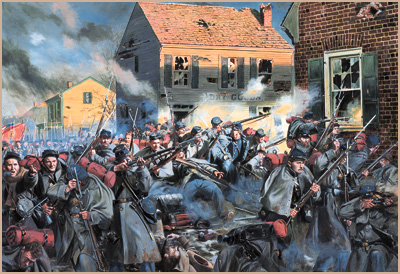
Remembering Our Veterans With Accuracy And Respect: Why It's Time For A Moratorium On Civil War Combat Art
Today is the day that we remember our Veterans, and take a moment to give respect to their commitment and sacrifice. In this space, we consider how we have and continue to remember the American Civil War. Which brings us to the substance of this post, wherein I wish to again posit a criticism of the use of Civil War combat as a form of consumer art, especially when that work is given credit for "realism". I refer you please to my previous post on the subject where the work of Don Troiani, one of the most prolific ACW artists, was discussed.
The utter lack of reality within this medium resurfaced during the recent book chat on "Harvard's Civil War" a text with Troiani's "Fire on Caroline Street" on the cover. I brought this issue up in the chat given we were discussing the 20th Massachusetts Regiment's experience at the Battle of Fredericksburg. I presented my take on the complete absence of trauma or blood and mentioned this glaring lack of accuracy and candor in Troiani's work. Several of the people in the chat mentioned how they'd never noticed that before.
Somehow in the 147 years since the Civil War, amidst the mythologizing and glorifying, we've forgotten what a brutal and gruesome experience this was for the men who fought it. At some point, the reality of Civil War combat has given way to something that is acceptable to hang on the wall of someone's home. We've neglected, or perhaps chosen to consciously ignore or subconsciously block out, the grim realities that faced soldiers and civilians on Civil War battlefields.
This type of treatment is not so widely seen with other American wars. For example, The Jess and I did a Google and EBay search for artwork about the Normandy landings on June 6, 1944. There is a minute commercial market for such work, which demonstrates that it isn't, and by extension shouldn't, be roundly accepted. Too many people remember exactly what happened that day, and our memories of it are too stark and raw to be dumbed down like that.
So how come this sort of art is acceptable with regards to the Civil War? These paintings, and many others, are praised for their accuracy and bought and sold as commodities. They depict famous battle moments, to be sure, but the most salient point is that men, in the moments that are so memorable, also bled, suffered, and died on those spots. I do not believe the best way to remember what happened there is through this type of sanitized glorification of something truly awful.
The citizenry during the war, especially after the Battle of Shiloh, knew exactly what was happening. They were the first citizens to see the brutal reality of war through the camera lens, and communities were flooded with the wounded, and cemeteries filled with the dead. There were of course contemporary artist renderings of Civil War fighting, most from journalists and troops who witnessed fighting. This art, while certainly not as refined as Mr. Troiani's, pulled no punches when it came to showing destruction and death. You may be sure these depictions weren't getting slapped up on the walls of private homes.
There was no hiding from the realities of war in 1861-1865, and the Civil War should have been a seminal event in the way we think about war, one that would hopefully discourage us from ever wanting to see another. Somehow, this didn't happen. There is indeed a disconnect between the way we choose to think about Civil War combat and what actually transpired, and it is fed by this sort of pulp art that is only selectively correct and maximally palatable, but certainly not reality.
We have a responsibility to remember what soldiers in our wars have done, and we must emphasize the requirement that we do this honestly. It is not only inaccurate, but dishonest to continue to present Civil War combat in the way that we have become used to. To help cement my point, I give you some words from Mr. Troiani himself, quoted from www.historicalartprints.com:
"If an historical painting is not reasonably accurate, then it's worthless both as art and as a historical document," Troiani declares. "If you are going to become involved in this field then there is little excuse for a pattern of inaccuracies."
Couldn't have said it better myself.
The utter lack of reality within this medium resurfaced during the recent book chat on "Harvard's Civil War" a text with Troiani's "Fire on Caroline Street" on the cover. I brought this issue up in the chat given we were discussing the 20th Massachusetts Regiment's experience at the Battle of Fredericksburg. I presented my take on the complete absence of trauma or blood and mentioned this glaring lack of accuracy and candor in Troiani's work. Several of the people in the chat mentioned how they'd never noticed that before.
Somehow in the 147 years since the Civil War, amidst the mythologizing and glorifying, we've forgotten what a brutal and gruesome experience this was for the men who fought it. At some point, the reality of Civil War combat has given way to something that is acceptable to hang on the wall of someone's home. We've neglected, or perhaps chosen to consciously ignore or subconsciously block out, the grim realities that faced soldiers and civilians on Civil War battlefields.
This type of treatment is not so widely seen with other American wars. For example, The Jess and I did a Google and EBay search for artwork about the Normandy landings on June 6, 1944. There is a minute commercial market for such work, which demonstrates that it isn't, and by extension shouldn't, be roundly accepted. Too many people remember exactly what happened that day, and our memories of it are too stark and raw to be dumbed down like that.
So how come this sort of art is acceptable with regards to the Civil War? These paintings, and many others, are praised for their accuracy and bought and sold as commodities. They depict famous battle moments, to be sure, but the most salient point is that men, in the moments that are so memorable, also bled, suffered, and died on those spots. I do not believe the best way to remember what happened there is through this type of sanitized glorification of something truly awful.
The citizenry during the war, especially after the Battle of Shiloh, knew exactly what was happening. They were the first citizens to see the brutal reality of war through the camera lens, and communities were flooded with the wounded, and cemeteries filled with the dead. There were of course contemporary artist renderings of Civil War fighting, most from journalists and troops who witnessed fighting. This art, while certainly not as refined as Mr. Troiani's, pulled no punches when it came to showing destruction and death. You may be sure these depictions weren't getting slapped up on the walls of private homes.
There was no hiding from the realities of war in 1861-1865, and the Civil War should have been a seminal event in the way we think about war, one that would hopefully discourage us from ever wanting to see another. Somehow, this didn't happen. There is indeed a disconnect between the way we choose to think about Civil War combat and what actually transpired, and it is fed by this sort of pulp art that is only selectively correct and maximally palatable, but certainly not reality.
We have a responsibility to remember what soldiers in our wars have done, and we must emphasize the requirement that we do this honestly. It is not only inaccurate, but dishonest to continue to present Civil War combat in the way that we have become used to. To help cement my point, I give you some words from Mr. Troiani himself, quoted from www.historicalartprints.com:
"If an historical painting is not reasonably accurate, then it's worthless both as art and as a historical document," Troiani declares. "If you are going to become involved in this field then there is little excuse for a pattern of inaccuracies."
Couldn't have said it better myself.
Monday, November 10, 2008
James McPherson On Virtual Book Signing
I just finished watching the anticipated (at least by me) interview of Dr. James McPherson on virtualbooksigning.net. He was discussing his new book "Tried by War". What a blast it was, listening in and taking notes along the way to set up this post and also to help cement some of the salient points for my upcoming period of study of President Lincoln. I figure I'll start sometime late next year and into the next in anticipation of the 150th anniversary of Lincoln's election.
So whither McPherson and his new book? The impetus behind this book was the idea that little attention has been paid to Lincoln as commander-in-chief. He spoke about how Lincoln spent inordinate amounts of time studying, evaluating, and prosecuting the war, and how his process as commander in chief mirrored the way he both became and worked as an attorney.
Lincoln was not a great natural strategist, he had to work hard at it, just like he was a self-taught attorney. He spent time reading and cross-examining those around him who were knowledgeable, he could probe to depths of an issue and get to its essence, then utilize probably his greatest strength, his ability to communicate these complex ideas to any person at any level, from his own cabinet to far-flung regions of the Union.
In this effort, Lincoln not only satisfied his stated war aims, but extended the powers of the Executive branch and helped define the idea of war powers. In fact, he was the first president to ever use that term.
It's pretty amazing listening to Dr. McPherson discuss Lincoln and the Civil War. He clearly has an unparalleled command of the subject and also happens to have a great speaking voice. It is little wonder he is such a highly sought-after speaker and professor.
Virtual Book Signing and the Abraham Lincoln Bookstore did a fantastic job presenting this lecture, and of course my signed copy is in the mail. I also think I saw Mr. Triathlon's name in the list of patrons who bought a signed copy of the book. I ordered mine yesterday, so my order fell in the "many others" category. Anyway, if you missed it, it should be archived soon and available for free.
So whither McPherson and his new book? The impetus behind this book was the idea that little attention has been paid to Lincoln as commander-in-chief. He spoke about how Lincoln spent inordinate amounts of time studying, evaluating, and prosecuting the war, and how his process as commander in chief mirrored the way he both became and worked as an attorney.
Lincoln was not a great natural strategist, he had to work hard at it, just like he was a self-taught attorney. He spent time reading and cross-examining those around him who were knowledgeable, he could probe to depths of an issue and get to its essence, then utilize probably his greatest strength, his ability to communicate these complex ideas to any person at any level, from his own cabinet to far-flung regions of the Union.
In this effort, Lincoln not only satisfied his stated war aims, but extended the powers of the Executive branch and helped define the idea of war powers. In fact, he was the first president to ever use that term.
It's pretty amazing listening to Dr. McPherson discuss Lincoln and the Civil War. He clearly has an unparalleled command of the subject and also happens to have a great speaking voice. It is little wonder he is such a highly sought-after speaker and professor.
Virtual Book Signing and the Abraham Lincoln Bookstore did a fantastic job presenting this lecture, and of course my signed copy is in the mail. I also think I saw Mr. Triathlon's name in the list of patrons who bought a signed copy of the book. I ordered mine yesterday, so my order fell in the "many others" category. Anyway, if you missed it, it should be archived soon and available for free.
More Analysis Of "The Peculiar Institution"
I reviewed Kenneth Stampp's seminal treatment of slavery, titled "The Peculiar Institution" here several months ago. I'm pleased to see Rene Tyree, who runs Wigs-Wags, one of the best ACW blogs out there, reading and considering this book. Please take a look at his new post about it, the comment that I entered is below. I'm keen to see his response and please chime in on this issue whether you've read the book or not.
"I was struck, when I read the book, how Stampp used the work “positive” to describe those incentives. I don’t think it was for lack of a better term, I think he used it in a tongue-in-cheek manner. He knew full well how disgraceful it was to treat another human being like this, but managed to keep such editorial comment out of his book, which is one of it’s strengths. In using the word “positive”, I think he’s venting a little bit to show how there’s nothing at all positive about slavery"
"I was struck, when I read the book, how Stampp used the work “positive” to describe those incentives. I don’t think it was for lack of a better term, I think he used it in a tongue-in-cheek manner. He knew full well how disgraceful it was to treat another human being like this, but managed to keep such editorial comment out of his book, which is one of it’s strengths. In using the word “positive”, I think he’s venting a little bit to show how there’s nothing at all positive about slavery"
Friday, October 31, 2008
Housekeeping And Some Great Blogs
As I have received some much-appreciated attention from a few esteemed fellow bloggers, I am excited to return the favor in kind. I thoroughly enjoy being a part of this community, and take great pride in being able to recognize stellar work as I come across it.
I direct you first, please, to a blog called Wig-Wags. This work is presented by Rene Tyree, a grad student at American Military University who is focusing on the Civil War. I love what I do for a living and loved my graduate education, but that does sound like fun. Anyway, if you want a comprehensive walk through the causes of the war among a host of other choices, not the least of which are the stellar book reviews, then you must turn here.
For a plentitude of book reviews (he's reading Glatthaar's "Everyman's War"), and news stories, get to Civil War Librarian.
Jim Beeghley (now Dr. Jim Beeghley, well done) runs a blog called Teaching The Civil War With Technology. This sort of effort is going to be a cornerstone in helping focus people's interests in learning about the war, disseminating information, and furthering research. Spend some time looking at the picture in the title bar, I love it! The Google Time Line Feature is pretty sweet, too.
Other bits and pieces...
-I may be able to deliver my lecture on the 20th Massachusetts Regiment at Gettysburg two more time next year; to the Orange County Roundtable and the Inland Empire Roundtable. I'm very excited about these opportunities, just need to get the dates to jibe.
-The Civil War Network is unfortunately down due to equipment issues, but fortunately not out. Can't wait for it to get back online
-This Sunday is chapters 7-8 of Miller's "Harvard's Civil War" at Civil War Interactive's book chat. It's an amazing book, and a cornerstone of research for my aforementioned lecture, and the conversation has been quite lively. It's free to participate.
-I've read and posted all of the comments that have been coming in, thanks and keep 'em coming!
I direct you first, please, to a blog called Wig-Wags. This work is presented by Rene Tyree, a grad student at American Military University who is focusing on the Civil War. I love what I do for a living and loved my graduate education, but that does sound like fun. Anyway, if you want a comprehensive walk through the causes of the war among a host of other choices, not the least of which are the stellar book reviews, then you must turn here.
For a plentitude of book reviews (he's reading Glatthaar's "Everyman's War"), and news stories, get to Civil War Librarian.
Jim Beeghley (now Dr. Jim Beeghley, well done) runs a blog called Teaching The Civil War With Technology. This sort of effort is going to be a cornerstone in helping focus people's interests in learning about the war, disseminating information, and furthering research. Spend some time looking at the picture in the title bar, I love it! The Google Time Line Feature is pretty sweet, too.
Other bits and pieces...
-I may be able to deliver my lecture on the 20th Massachusetts Regiment at Gettysburg two more time next year; to the Orange County Roundtable and the Inland Empire Roundtable. I'm very excited about these opportunities, just need to get the dates to jibe.
-The Civil War Network is unfortunately down due to equipment issues, but fortunately not out. Can't wait for it to get back online
-This Sunday is chapters 7-8 of Miller's "Harvard's Civil War" at Civil War Interactive's book chat. It's an amazing book, and a cornerstone of research for my aforementioned lecture, and the conversation has been quite lively. It's free to participate.
-I've read and posted all of the comments that have been coming in, thanks and keep 'em coming!
Thursday, October 30, 2008
Studying The Lost Cause Mythology Is Getting Popular!
I'm thrilled with the response that my posts about the Lost Cause mythology are starting to get, and the comments are fantastic. I've decided to provide a series of links to previous posts for easy use for people to start at the beginning of this program. You can, of course, also click on the "Lost Cause" link in the right sidebar.
For sake of ease, I'm only going to list the primary posts in this discussion, but I encourage everyone to scroll through the Lost Cause catalog, I'm sure some of the other musings will grab your interest, and don't forget the book reviews.
Please enjoy, and comments are welcome and encouraged. I'll get them posted with a response as soon as possible!
-this post has links to three previous posts and a summary of what we're going to work through
-the mythology surrounding Robert E Lee is covered here
-you may have noticed that I like to encourage readers to think about how they were taught about various events and personalities in the war, so we can compare what we learned and how we remember with what really happened. This post examines a video clip where I examine how this occurs.
-there are many reasons why the Lost Cause mythology emerged, not the least of which was that rigorous historical method and modern research techniques were either not available or not brought to bear. In this post, all of that begins to change, thanks to the work of Dr. Joseph Glattaar.
-here we begin our discussion of Stonewall Jackson
For sake of ease, I'm only going to list the primary posts in this discussion, but I encourage everyone to scroll through the Lost Cause catalog, I'm sure some of the other musings will grab your interest, and don't forget the book reviews.
Please enjoy, and comments are welcome and encouraged. I'll get them posted with a response as soon as possible!
-this post has links to three previous posts and a summary of what we're going to work through
-the mythology surrounding Robert E Lee is covered here
-you may have noticed that I like to encourage readers to think about how they were taught about various events and personalities in the war, so we can compare what we learned and how we remember with what really happened. This post examines a video clip where I examine how this occurs.
-there are many reasons why the Lost Cause mythology emerged, not the least of which was that rigorous historical method and modern research techniques were either not available or not brought to bear. In this post, all of that begins to change, thanks to the work of Dr. Joseph Glattaar.
-here we begin our discussion of Stonewall Jackson
Monday, October 27, 2008
Another Strong Gettysburg Blog With Tons Of Pictures
Like Gettysburg365.com, which I found a few weeks ago, Gettysburg Daily puts up a near-daily image set from Gettysburg. I was instantly hooked when I found the Little Round Top during the change of seasons. It's a fun project working through their archives, that's for sure. They even have a series of pictures of Gettysburg witness trees, click here to see for yourself.
Also, I have a few words of wisdom and insight from Tom Friedman from Sunday's NY Times
Subscribe to:
Posts (Atom)


 Posts
Posts