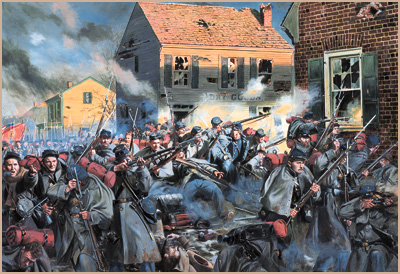
Remember those questionnaires in junior high and high school that would help determine the "best way" you learn? I always thought those were junk, personally. A little viewing, some writing, a bit of listening, a good mixture was the key to a rich understanding of a subject. Thus I bring you the Civil War in three different media and three different themes.
First a furthering of the discussion of Civil War art that has been undertaken here and elsewhere. Cenantua's Blog and Civil War Memory brought me to this post at Vast Public Indifference, a blog I've followed for sometime, but had gotten a bit behind on. The video clip at the bottom is a fabulous juxtaposition and illustrates the fusion of Civil War art and the Lost Cause mythology.
I refer you to our previous discussions of Generals Lee and Jackson, and thus armed, you will see some striking imagery with a frankly bizarre, almost delusional grasp of the past in the song lyrics.
The overwritten commentary is like a breath of fresh air in a room that had the doors and windows closed for nearly 200 years (not a bad simile, if I do say so). This is a nice mix of reading, listening, and watching, so everyone is sure to get something out of it. Also, the unforgiving perspective she gives on the paintings and song lyrics is just right on the money.
But wait, you say you want to read more? Well then I provide you with a selection of new Civil War oriented blogs to choose from, and you can peruse to your heart's delight.
Draw The Sword: This is a fabulous blog maintained by Jenny Goellnitz focusing on Gettysburg monuments. What sets this blog apart is the "Find A Unit" function she has set up. See it for yourself. Fantastic!
This Mighty Scourge: A study of small units from brigade-level on down, also provides frequent posts "this day during the war" posts.
South From the North Woods: A blog by an Antietam park ranger and colleague of Mannie Gentile
Renegade South: A study of Southern Unionist sentiment by Victoria Bynum. An outstanding and diverse exploration of a challenging subject.
If you're sick of reading, and want to get back to a more auditory experience, well then just come out to Huntington Beach, CA tomorrow night and catch me delivering my lecture on the 20th Massachusetts Volunteer Infantry to the Orange County Civil War Roundtable. Same material as last August, but totally different audience, should be good fun.
Showing posts with label Lost Cause. Show all posts
Showing posts with label Lost Cause. Show all posts
Monday, February 16, 2009

Monday, February 2, 2009
Book Review: "This Republic Of Suffering"
I've waited months to read Drew Gilpin Faust's "This Republic of Suffering", and now that I'm done, wish I'd read it immediately. This book has been nominated for a few major awards and the accolades were well-deserved. I want to add my two cents to the legion of reviews that followed this book's release last year.
Writing history takes courage. The act of recording events and providing analysis may sometimes require a researcher to cover material they find sad, abhorrent, embarrassing, inexcusable. The true scholar has the fortitude to minimize their personal concerns and emotions and provide a clear and unabashed view of the subject in question.
Most of those who first studied and analyzed the American Civil War unfortunately did not have this intrinsic strength and insight. People like Early, Gordon, Pendleton et al instead let their own interests, grievances, and shame influence their writing, with the inevitable result being the mythology of the Lost Cause.
The next wave of historians who wrote books that would carry into generations of students that followed, men like Bruce Catton, Shelby Foote, and Douglas Southall Freeman, lacked the skill and vision to present the war in its full, gruesome reality. Instead, leaders were glorified and charges were immortalized, intentions were obscured and fables were propagated. The illustration of an entire nation's suffering was a secondary priority.
Now, there is a new tide in the historical analysis of the Civil War and historians of recent years are finally showing the acumen and stoutheartedness that considering such a destructive and horrible thing as war requires. Dr. Faust and "This Republic of Suffering" are at the forefront of this effort. Her truly unique analysis of death in the Civil War helps fan away the obfuscating haze of romanticism and mythology that still surrounds our understanding of the Civil Warand shows just how horrible, painful, and all-encompassing the slaughter was.
There is no nobility here, no heroic charges praised in painting and re-enactment. This is a comprehensive look at how those who lost a loved one, those who faced death, and those who dealt it handled these enormous burdens. This is the first time this subject has been treated so comprehensively (only took 140-something years) and for that fact alone, this book is important.
In addition to its unique subject matter, this is just damn good historiography. From sourcing to writing, this book is how it is done.
More than anything else, "This Republic of Suffering" is just tremendously sad. Sad for the men who didn't want to die, sad for the families who could never find their son's body, sad for those who had to kill. Sad for those who would craft an entire mythology around the war so they could better cope with what they had wrought.
It is exactly this book's emotional slap in the face that makes it such an important work. This story is our story, how we killed each other, suffered, and grieved during a terrible time in our nation's history. Here, finally, is a book that focuses solely on just how painful this war was for our society.
Nothing is sugarcoated and there is no glamour. There is no brawling over who was a better leader, who was more religious, who was or wasn't inept, any of the goofiness that so many post-war writers and subsequent historians brewed up to help us escape from the fact that fully 6% of our nation's population was dead. It is because those who first sat down to write the war's story, and the Freemans, Footes, and Cattons who followed them with thick tomes of bloviating and myth didn't have the onions to include this gritty subject matter. By abdicating this responsibility, these "historians" have left our society to deal with a tremendous amount of misunderstanding.
It is because there are historians like Faust with the courage to write the war's hard reality and folks who buy, read, and discuss "This Republic of Suffering" that we will continue to find a truer understanding and memory of the Civil War, and, hopefully, a better conception of who we are as an undivided society.
Writing history takes courage. The act of recording events and providing analysis may sometimes require a researcher to cover material they find sad, abhorrent, embarrassing, inexcusable. The true scholar has the fortitude to minimize their personal concerns and emotions and provide a clear and unabashed view of the subject in question.
Most of those who first studied and analyzed the American Civil War unfortunately did not have this intrinsic strength and insight. People like Early, Gordon, Pendleton et al instead let their own interests, grievances, and shame influence their writing, with the inevitable result being the mythology of the Lost Cause.
The next wave of historians who wrote books that would carry into generations of students that followed, men like Bruce Catton, Shelby Foote, and Douglas Southall Freeman, lacked the skill and vision to present the war in its full, gruesome reality. Instead, leaders were glorified and charges were immortalized, intentions were obscured and fables were propagated. The illustration of an entire nation's suffering was a secondary priority.
Now, there is a new tide in the historical analysis of the Civil War and historians of recent years are finally showing the acumen and stoutheartedness that considering such a destructive and horrible thing as war requires. Dr. Faust and "This Republic of Suffering" are at the forefront of this effort. Her truly unique analysis of death in the Civil War helps fan away the obfuscating haze of romanticism and mythology that still surrounds our understanding of the Civil Warand shows just how horrible, painful, and all-encompassing the slaughter was.
There is no nobility here, no heroic charges praised in painting and re-enactment. This is a comprehensive look at how those who lost a loved one, those who faced death, and those who dealt it handled these enormous burdens. This is the first time this subject has been treated so comprehensively (only took 140-something years) and for that fact alone, this book is important.
In addition to its unique subject matter, this is just damn good historiography. From sourcing to writing, this book is how it is done.
More than anything else, "This Republic of Suffering" is just tremendously sad. Sad for the men who didn't want to die, sad for the families who could never find their son's body, sad for those who had to kill. Sad for those who would craft an entire mythology around the war so they could better cope with what they had wrought.
It is exactly this book's emotional slap in the face that makes it such an important work. This story is our story, how we killed each other, suffered, and grieved during a terrible time in our nation's history. Here, finally, is a book that focuses solely on just how painful this war was for our society.
Nothing is sugarcoated and there is no glamour. There is no brawling over who was a better leader, who was more religious, who was or wasn't inept, any of the goofiness that so many post-war writers and subsequent historians brewed up to help us escape from the fact that fully 6% of our nation's population was dead. It is because those who first sat down to write the war's story, and the Freemans, Footes, and Cattons who followed them with thick tomes of bloviating and myth didn't have the onions to include this gritty subject matter. By abdicating this responsibility, these "historians" have left our society to deal with a tremendous amount of misunderstanding.
It is because there are historians like Faust with the courage to write the war's hard reality and folks who buy, read, and discuss "This Republic of Suffering" that we will continue to find a truer understanding and memory of the Civil War, and, hopefully, a better conception of who we are as an undivided society.
Friday, January 30, 2009
The Confederate Battle Flag And Civil War Memory
The debate and emotion generated by the Confederate flag flying in Tampa not only captures what a hot-button topic this symbol still is, but how comprehensive our disconnect with the actual history of it. Example: while this flag is referred to as "the" Confederate flag, there actually was no national flag of the Confederacy until maybe 1863. This flag was also not the battle flag of the entire Confederacy, late in the war it was the battle flag of the Army of Northern Virginia. From this it has metamorphosed into a political hot potato, a divisive insult, beach towel kitsch, and a NASCAR staple.
Okay, clearly this subject requires more study, and thankfully I think I found the resource at Point Loma books in San Diego (a smashing addition to the list of San Diego used/independent bookstores). John Coski, the director of the Museum of the Confederacy, wrote a book called "The Confederate Battle Flag" which provides a comprehensive discussion of the history of this flag's cultural evolution. Don't let preconceptions about the Museum of the Confederacy fool you, Mr. Coski is a scholar of a high order, and his interview on NPR in 2005 (which you can listen to by clicking here) gives evidence of that fact.
I'm going to try something a bit different with this book; instead of reviewing it en bloc when I'm done, we'll take it piece by piece as I move through it. Feel free to get a copy for yourself and join me.
Okay, clearly this subject requires more study, and thankfully I think I found the resource at Point Loma books in San Diego (a smashing addition to the list of San Diego used/independent bookstores). John Coski, the director of the Museum of the Confederacy, wrote a book called "The Confederate Battle Flag" which provides a comprehensive discussion of the history of this flag's cultural evolution. Don't let preconceptions about the Museum of the Confederacy fool you, Mr. Coski is a scholar of a high order, and his interview on NPR in 2005 (which you can listen to by clicking here) gives evidence of that fact.
I'm going to try something a bit different with this book; instead of reviewing it en bloc when I'm done, we'll take it piece by piece as I move through it. Feel free to get a copy for yourself and join me.
Tuesday, January 27, 2009
So Explain It Already!
The quote from the member of the Sons of Confederate Veterans justifying the enormous Confederate flag flying in Tampa, "we fly it so we can explain it" prompted me to do a bit of research to explore how serious the SCV was about educating the curious about their motivations.
I looked at both the main SCV website and the site for the Florida chapter, the main site makes absolutely no mention of it, the Florida site has a picture of the flag, but no essays, comments, editorials, or illustrative links.
Basically, there is absolutely no thought, content, consideration, or insight behind what they are doing with this ridiculous flag. The SCV Florida chapter is behaving like a screaming child looking for attention by pressing the buttons it knows will get a response. Moreover, the glaring lack of discussion on these sites makes this organization look absolutely foolish.
There's no accurate representation of history anywhere near the SCV, this is just a bunch of chest thumping, a gasp for acknowledgement while society, philosophy, morality, and the world pass them by. Maybe it's not an accident this flag is near an interstate highway, people will just glance at it in their rearview mirror.
I looked at both the main SCV website and the site for the Florida chapter, the main site makes absolutely no mention of it, the Florida site has a picture of the flag, but no essays, comments, editorials, or illustrative links.
Basically, there is absolutely no thought, content, consideration, or insight behind what they are doing with this ridiculous flag. The SCV Florida chapter is behaving like a screaming child looking for attention by pressing the buttons it knows will get a response. Moreover, the glaring lack of discussion on these sites makes this organization look absolutely foolish.
There's no accurate representation of history anywhere near the SCV, this is just a bunch of chest thumping, a gasp for acknowledgement while society, philosophy, morality, and the world pass them by. Maybe it's not an accident this flag is near an interstate highway, people will just glance at it in their rearview mirror.
Look Away
The Sons of Confederate Veterans chapter that hoisted that gigantic Confederate flag in Tampa, Florida is about to get its 15 minutes of fame extended. That 60x90 foot symbol of repression and slavery is going to be flying during the Super Bowl week.
"We fly it so we can explain it" said one SCV member when asked by the press what the motives are in this endeavor. Does that explanation include a discussion of slavery in the United States and its primary role in Southern secession and Civil War?
There is no small amount of irony that this flag was made in China. Whenever the relationship of forced labor and this flag is presented, the SCV tries to separate the two as much as possible. Given that denial, you would think they might want to demonstrate how this flag was made by well-paid, fairly-treated workers, perhaps from the region it represented.
There's just so much wrong about this flag and its display in this manner. The one thing that is not wrong is the group's right to fly it. They have the same freedom to fly it as I have to rip them for being disingenuous in their motives and ignorant of the fact that this flag has many meanings to many people. It may represent some Lost Cause apologia to some, but that doesn't give them the monopoly on symbolism. To millions of others this flag, and other flags of the Confederacy, represent a society built upon the enslavement of others and a rebellion fomented to protect that institution.
We've come so far as a country and the last few months have brought such a sense of pride and energy despite the challenges we face. This flag display could be a detractor, but I say we just leave these agitators in the dust behind us as we move forward. "What they are talking about does not represent the values of Hillsborough County," said Curtis Stokes, the president of the Hillsborough County branch of the National Association for the Advancement of Colored People. "All they want is publicity."
He's right, just absolutely right. While we can't take the flag down and most of the people who helped raise this one are unlikely to extend their worldview, we can turn away, drive away, walk away back to our communities where the values behind this flag have no foothold.
"We fly it so we can explain it" said one SCV member when asked by the press what the motives are in this endeavor. Does that explanation include a discussion of slavery in the United States and its primary role in Southern secession and Civil War?
There is no small amount of irony that this flag was made in China. Whenever the relationship of forced labor and this flag is presented, the SCV tries to separate the two as much as possible. Given that denial, you would think they might want to demonstrate how this flag was made by well-paid, fairly-treated workers, perhaps from the region it represented.
There's just so much wrong about this flag and its display in this manner. The one thing that is not wrong is the group's right to fly it. They have the same freedom to fly it as I have to rip them for being disingenuous in their motives and ignorant of the fact that this flag has many meanings to many people. It may represent some Lost Cause apologia to some, but that doesn't give them the monopoly on symbolism. To millions of others this flag, and other flags of the Confederacy, represent a society built upon the enslavement of others and a rebellion fomented to protect that institution.
We've come so far as a country and the last few months have brought such a sense of pride and energy despite the challenges we face. This flag display could be a detractor, but I say we just leave these agitators in the dust behind us as we move forward. "What they are talking about does not represent the values of Hillsborough County," said Curtis Stokes, the president of the Hillsborough County branch of the National Association for the Advancement of Colored People. "All they want is publicity."
He's right, just absolutely right. While we can't take the flag down and most of the people who helped raise this one are unlikely to extend their worldview, we can turn away, drive away, walk away back to our communities where the values behind this flag have no foothold.
Saturday, January 3, 2009
Book Review: "Lee's Tarnished Lieutenant"
The journey of General James Longstreet through history is a remarkable insight into the fickle response of history to those who help make it. Few officers were more important to the Confederate war effort, arguably no officer was more beloved by General Robert E Lee (who called him his "war horse" and camped next to him every night), perhaps no commander had a better grasp of defensive and counter-offensive warfare.
More important than all of these plaudits is the fact that, despite this incredible war record, no single Confederate general has been more smeared and defamed by the Lost Cause mythology than General Longstreet. It is this evolution that William Piston takes on in his book "Lee's Tarnished Lieutenant".
Piston does a strong job working through Longstreet's war record and his incredibly close relationship with Lee during the war. He also captures an interesting point; despite his successes and leadership, his popularity paled in comparison to Virginians like Lee, J.E.B. Stuart, and Stonewall Jackson. The point is made, successfully for that matter, that because Longstreet was not from the state of Virginia, he never captured the heart of the Old Dominion and would be plagued by this separation long after the war was over.
Despite this, when the war was over, the initial writings about Longstreet were filled with praise and respect for his efforts. A few years later, Piston shows us an intersection of events that brought Longstreet to the forefront of the battle over the war's memory and the rise of the Lost Cause;
#1: the death of General Lee in 1870.
#2: Longstreet's becoming a Republican and publicly voicing support of the Reconstruction government.
#3: General Jubal Early, William Nelson Pendleton, and Reverend John Jones launching a public relations campaign, starting with Early's speech to Washington College on January 19, 1872, that would become "one of the cleverest orchestrations of innuendo and unsubstantiated accusations in American historiography."
With Lee's death in 1870 before he'd written even a manuscript of his memoirs about the war , there was a surge of interest in capturing and celebrating his memory. Piston carefully introduces us to the characters that took in upon themselves to elevate Lee to the beatific status he enjoyed for over one hundred years, as well as the techniques they used to do it.
Simply put, just like Newton's Third Law tells us, the action to elevate Lee required the opposite action of defaming Longstreet. Piston (and many authors who have tackled this subject matter described the development of Longstreet as Judas Iscariot to Lee's Christ-like status.
This is best illustrated by the "Longstreet Lost the War at Gettysburg" myth, all based on a lie perpetrated by William Pendleton (stay tuned, a post on this phenomenon will be forthcoming.) Longstreet made an easy target, not just because he wasn't a Virginian, but because he openly supported the Republican government, was thought to be betraying the tenets of the Confederacy he had fought for. Longstreet's clumsy and arrogant responses to these men did little to help his cause.
This book is less an apologia for General Longstreet as it is a scathing indictment of the personalities and agendas that set about smearing him as a part of the larger construction of the Lost Cause mythology. Piston is sometimes quite unsympathetic towards Longstreet, especially regarding his responses to those who would defame him; but this does not subtract from his pointed study of the manipulation and dishonesty perpetrated by men like Early et al, as well as influential historians that followed in the decades after the war, first among them Douglas Southall Freeman.
This all starts with the title of the book. By calling his work "Lee's Tarnished Lieutenant", Piston is clearly co-opting the title of Freeman's "Lee Lieutenants", a work which went a long way towards cementing the fables created around the Confederacy after the war. Piston carries us through not only the nitty-gritty of how a Confederate war hero became defamed and despised, but also how that myth perpetuated itself through the near 150 years since. From the United Daughters of the Confederacy applying pressure on schools regarding textbook content to Freeman's lavish use of hearsay and editorial comment, Longstreet's reputation never had a chance.
General Longstreet is as good a general as the Confederacy had; a fact recognized during and immediately after the war. In the years that followed, he would fall under the heels of the Lost Cause and its veneration of Lee to the point where he bore the blame for Gettysburg and bore yoke of Confederate defeat. Piston's text does a wonderful job of detailing and describing this evolution, leaving the reader to shake their head in disbelief at just how powerful a force the Lost Cause mythology was and still remains.
More important than all of these plaudits is the fact that, despite this incredible war record, no single Confederate general has been more smeared and defamed by the Lost Cause mythology than General Longstreet. It is this evolution that William Piston takes on in his book "Lee's Tarnished Lieutenant".
Piston does a strong job working through Longstreet's war record and his incredibly close relationship with Lee during the war. He also captures an interesting point; despite his successes and leadership, his popularity paled in comparison to Virginians like Lee, J.E.B. Stuart, and Stonewall Jackson. The point is made, successfully for that matter, that because Longstreet was not from the state of Virginia, he never captured the heart of the Old Dominion and would be plagued by this separation long after the war was over.
Despite this, when the war was over, the initial writings about Longstreet were filled with praise and respect for his efforts. A few years later, Piston shows us an intersection of events that brought Longstreet to the forefront of the battle over the war's memory and the rise of the Lost Cause;
#1: the death of General Lee in 1870.
#2: Longstreet's becoming a Republican and publicly voicing support of the Reconstruction government.
#3: General Jubal Early, William Nelson Pendleton, and Reverend John Jones launching a public relations campaign, starting with Early's speech to Washington College on January 19, 1872, that would become "one of the cleverest orchestrations of innuendo and unsubstantiated accusations in American historiography."
With Lee's death in 1870 before he'd written even a manuscript of his memoirs about the war , there was a surge of interest in capturing and celebrating his memory. Piston carefully introduces us to the characters that took in upon themselves to elevate Lee to the beatific status he enjoyed for over one hundred years, as well as the techniques they used to do it.
Simply put, just like Newton's Third Law tells us, the action to elevate Lee required the opposite action of defaming Longstreet. Piston (and many authors who have tackled this subject matter described the development of Longstreet as Judas Iscariot to Lee's Christ-like status.
This is best illustrated by the "Longstreet Lost the War at Gettysburg" myth, all based on a lie perpetrated by William Pendleton (stay tuned, a post on this phenomenon will be forthcoming.) Longstreet made an easy target, not just because he wasn't a Virginian, but because he openly supported the Republican government, was thought to be betraying the tenets of the Confederacy he had fought for. Longstreet's clumsy and arrogant responses to these men did little to help his cause.
This book is less an apologia for General Longstreet as it is a scathing indictment of the personalities and agendas that set about smearing him as a part of the larger construction of the Lost Cause mythology. Piston is sometimes quite unsympathetic towards Longstreet, especially regarding his responses to those who would defame him; but this does not subtract from his pointed study of the manipulation and dishonesty perpetrated by men like Early et al, as well as influential historians that followed in the decades after the war, first among them Douglas Southall Freeman.
This all starts with the title of the book. By calling his work "Lee's Tarnished Lieutenant", Piston is clearly co-opting the title of Freeman's "Lee Lieutenants", a work which went a long way towards cementing the fables created around the Confederacy after the war. Piston carries us through not only the nitty-gritty of how a Confederate war hero became defamed and despised, but also how that myth perpetuated itself through the near 150 years since. From the United Daughters of the Confederacy applying pressure on schools regarding textbook content to Freeman's lavish use of hearsay and editorial comment, Longstreet's reputation never had a chance.
General Longstreet is as good a general as the Confederacy had; a fact recognized during and immediately after the war. In the years that followed, he would fall under the heels of the Lost Cause and its veneration of Lee to the point where he bore the blame for Gettysburg and bore yoke of Confederate defeat. Piston's text does a wonderful job of detailing and describing this evolution, leaving the reader to shake their head in disbelief at just how powerful a force the Lost Cause mythology was and still remains.
Thursday, January 1, 2009
Moving Into 2009
It's now nighttime on the first day of 2009, and The Jess and I have rung in the New Year right! An excellent New Year's Eve dinner, some games, a big breakfast and a bunch of football. She's having a nap before dinner, and I want to share some thoughts I have for the direction of this space for the year.
So a few aesthetics first. The sidebar has been cleaned up for the New Year; I've taken the Reading List for 2008 and put it into a post with an archive link in the section, same with the Reasons Why The Jess Is Cool. Both will, I assure you, rapidly fill up over the course of '09. Also, I've removed the Recent Refreshment section, but any new drinks and roasts will most assuredly be written about.
This year, I plan to pick up a new thread of study by bringing together our work on the Lost Cause with extended readings on Reconstruction and its attendant difficulties and tragedies. This was spurred by some reading just before the end of the year when I completed Stephen Budiansky's "The Bloody Shirt". This book, along with Piston's "Lee's Tarnished Lieutenant", will be reviewed shortly, but the lid has been blown off of subject matter I haven't explored since my senior year at UCLA in 1998. I'm champing at the bit to get into this, we're in for some challenging and emotional work.
Texts by Blight, Foner, and Fitzgerald are going to be the cornerstones initially; these books are chosen because of their status as pillars of Reconstruction scholarship. I need to get back to fundamentals on this subject because Budiansky's book opened my eyes to just how deep our common misperceptions of Reconstruction run (and it wasn't even that great a book!)
As we move forward, I am prompted by a recent post at "Past in the Present" about citations of sources in blog posts. There is no industry standard, but as I have done in the past, please be assured that if you ever have a question about my source material, I will gladly provide any references I have used.
So a few aesthetics first. The sidebar has been cleaned up for the New Year; I've taken the Reading List for 2008 and put it into a post with an archive link in the section, same with the Reasons Why The Jess Is Cool. Both will, I assure you, rapidly fill up over the course of '09. Also, I've removed the Recent Refreshment section, but any new drinks and roasts will most assuredly be written about.
This year, I plan to pick up a new thread of study by bringing together our work on the Lost Cause with extended readings on Reconstruction and its attendant difficulties and tragedies. This was spurred by some reading just before the end of the year when I completed Stephen Budiansky's "The Bloody Shirt". This book, along with Piston's "Lee's Tarnished Lieutenant", will be reviewed shortly, but the lid has been blown off of subject matter I haven't explored since my senior year at UCLA in 1998. I'm champing at the bit to get into this, we're in for some challenging and emotional work.
Texts by Blight, Foner, and Fitzgerald are going to be the cornerstones initially; these books are chosen because of their status as pillars of Reconstruction scholarship. I need to get back to fundamentals on this subject because Budiansky's book opened my eyes to just how deep our common misperceptions of Reconstruction run (and it wasn't even that great a book!)
As we move forward, I am prompted by a recent post at "Past in the Present" about citations of sources in blog posts. There is no industry standard, but as I have done in the past, please be assured that if you ever have a question about my source material, I will gladly provide any references I have used.
Tuesday, December 30, 2008
The Tipsy Historian 2008 Year In Review
The New Year is always a special time, and this time around, more than ever. A recurring personality in these posts is my wife, The Jess, and 2008 was a most challenging year for her, for me, and for us as a couple. If you look in the archives there is a writing vacuum from late January into April, and the astute observer will note in the sidebar "Why The Jess Is Cool" the one notation that's in all capital letters.
We pushed through a tough stretch together and I've never been more proud of anyone or anything in my life than I am of her. We've both worked hard to keep some balance and brightness in our lives as some dark energy pushed against us, and we've been pretty successful. I'm grateful and happy that this space was a large part of my cognitive recreation and creativity, which I'm sure is evinced by the nearly 200 posts I wrote in just over 8 months.
This blog has served as an effective relaxation and mental escape technique over the past year, and I'm sure it will remain so, but hopefully without a sense of urgency or anxiety driving the work. And what a lot of work we've done! When I started blogging, I wondered what themes would develop within the subjects that draw my interest, and over the course of 2008, there were some most engaging threads developed.
The American Civil War rose far to the front here, and I'm incredibly happy and proud of our ongoing study of The Lost Cause mythology and our collective memory of the ACW. There are some fantastic blogs out there that I discovered over the course of the year that share this focus (Cenantua's Blog being right at the top of the heap), which has made the journey that much richer.
There is no shortage of controversy and emotion in this subject matter, and we've tackled a quite a few provocative issues. When you begin challenging long-established perceptions and beloved folklore, you're gonna stir up some emotions. I believe that this is important work and I'm glad that a visceral chord is struck here from time to time.
Though my reading list is chock-a-block with Civil War material, and the majority of posts here do cover this topic, no small amount of attention has been paid to the importance of a tasty beverage. Between roasting my own coffee and inventing drinks filled with black apricot, basil, cantaloupe, and cachaca, The Jess and I have not gone thirsty this year.
We also haven't been short of drama on the tennis court, whether I'm out grinding with Simon the Great or watching and writing about the four Grand Slams. Nothing comes anywhere close to the fun that I had writing about the surging rivalry between Roger Federer and Rafael Nadal, and no sporting event I've ever seen can even approach the sheer brilliance and stunning drama of their clash in the Wimbledon final this year.
So what's been my favorite post of the year? There are a few that I'm quite pleased with, several that have attracted some attention and comment, and a few that will quench a powerful thirst. None of them has the appeal that writing about my cousin Guy's journey to a world championship held for me. I was a sportswriter before I went to grad school, and it's a pursuit that I love and missed, up until this event happened. It was also an incredibly dramatic moment amidst a year that was well-drenched in sporting achievements.
The thrill of this occasion and the sheer joy we all felt seeing my cousin pull over this amazing feat will always be special to me for these reasons and one more. That moment helped break through a pall in my life and was the jump-off point for a tremendous source of recreation and fun for me. That April 21st post was my first in several months and stands up as a powerful symbol for me.
I look forward to moving into 2009 and anticipate another rich year of subject matter to write about. Before we make that transition, I would like to give a word of thanks to those who have spent a few moments reading my prose. This is a public place and I'm grateful to anyone who should happen by and spend some time here. I hope to see you again many times in a healthy and happy 2009!
We pushed through a tough stretch together and I've never been more proud of anyone or anything in my life than I am of her. We've both worked hard to keep some balance and brightness in our lives as some dark energy pushed against us, and we've been pretty successful. I'm grateful and happy that this space was a large part of my cognitive recreation and creativity, which I'm sure is evinced by the nearly 200 posts I wrote in just over 8 months.
This blog has served as an effective relaxation and mental escape technique over the past year, and I'm sure it will remain so, but hopefully without a sense of urgency or anxiety driving the work. And what a lot of work we've done! When I started blogging, I wondered what themes would develop within the subjects that draw my interest, and over the course of 2008, there were some most engaging threads developed.
The American Civil War rose far to the front here, and I'm incredibly happy and proud of our ongoing study of The Lost Cause mythology and our collective memory of the ACW. There are some fantastic blogs out there that I discovered over the course of the year that share this focus (Cenantua's Blog being right at the top of the heap), which has made the journey that much richer.
There is no shortage of controversy and emotion in this subject matter, and we've tackled a quite a few provocative issues. When you begin challenging long-established perceptions and beloved folklore, you're gonna stir up some emotions. I believe that this is important work and I'm glad that a visceral chord is struck here from time to time.
Though my reading list is chock-a-block with Civil War material, and the majority of posts here do cover this topic, no small amount of attention has been paid to the importance of a tasty beverage. Between roasting my own coffee and inventing drinks filled with black apricot, basil, cantaloupe, and cachaca, The Jess and I have not gone thirsty this year.
We also haven't been short of drama on the tennis court, whether I'm out grinding with Simon the Great or watching and writing about the four Grand Slams. Nothing comes anywhere close to the fun that I had writing about the surging rivalry between Roger Federer and Rafael Nadal, and no sporting event I've ever seen can even approach the sheer brilliance and stunning drama of their clash in the Wimbledon final this year.
So what's been my favorite post of the year? There are a few that I'm quite pleased with, several that have attracted some attention and comment, and a few that will quench a powerful thirst. None of them has the appeal that writing about my cousin Guy's journey to a world championship held for me. I was a sportswriter before I went to grad school, and it's a pursuit that I love and missed, up until this event happened. It was also an incredibly dramatic moment amidst a year that was well-drenched in sporting achievements.
The thrill of this occasion and the sheer joy we all felt seeing my cousin pull over this amazing feat will always be special to me for these reasons and one more. That moment helped break through a pall in my life and was the jump-off point for a tremendous source of recreation and fun for me. That April 21st post was my first in several months and stands up as a powerful symbol for me.
I look forward to moving into 2009 and anticipate another rich year of subject matter to write about. Before we make that transition, I would like to give a word of thanks to those who have spent a few moments reading my prose. This is a public place and I'm grateful to anyone who should happen by and spend some time here. I hope to see you again many times in a healthy and happy 2009!
Saturday, December 20, 2008
Touching Base And Providing Refreshments
Hello friends, hope everyone is having a happy and fulfilling holiday season thus far! It's been an energetic one here with births, family, trips, birthdays, lots of work and Hanukah preparations (remember to buy your books from local/independent bookstores)! So it follows that my blogging frequency has dipped a bit from my usual 5-7 posts per week.
I've finished Piston's book on Gen Longstreet, entitled "Lee's Tarnished Lieutenant", and am working through the themes of my review. As a little teaser trailer, this is one of the best studies of the Lost Cause and it's effects that I've yet read. We have some powerful and challenging issues to explore together.
This book has reinvigorated my desire to explore the Lost Cause, so my study of the Western Theater will wait until I finish Steven Budiansky's "The Bloody Shirt". I'm not a multiple-book-reader-at-the-same-time like some, so I have to stay focused. We've covered some important ground on this subject matter this year, so I'd like to do a year-end wrap of this blog's content.
Just so you don't go away thirsty, here's a little concoction I put together the other night. It received high praise from The Jess, so you know you're in business. It's a playful little interpretation of the gin and tonic, helps make sure that you get all of your medicine in one dose, quinine, vitamin C, everything. I'm assuming that as historians, we're all aware of how gin and tonic came together in the first place. Something to do with malaria...
Your Daily Dose
1.5 oz Tanqueray Ten
3 oz Schweppes tonic water
0.5 oz fresh squeezed orange juice
one strip mandarin orange peel
thick slice of kiwi fruit
Add gin and tonic to a Collins glass filled with ice, pour orange juice in next. Give gentle stir with stirring rod, then twist mandarin peel over top to release oils. Don't add peel itself to drink. Float kiwi slice on top of ice and enjoy. At the end of the drink, be sure to fish out the kiwi , it'll taste incredible!
I've finished Piston's book on Gen Longstreet, entitled "Lee's Tarnished Lieutenant", and am working through the themes of my review. As a little teaser trailer, this is one of the best studies of the Lost Cause and it's effects that I've yet read. We have some powerful and challenging issues to explore together.
This book has reinvigorated my desire to explore the Lost Cause, so my study of the Western Theater will wait until I finish Steven Budiansky's "The Bloody Shirt". I'm not a multiple-book-reader-at-the-same-time like some, so I have to stay focused. We've covered some important ground on this subject matter this year, so I'd like to do a year-end wrap of this blog's content.
Just so you don't go away thirsty, here's a little concoction I put together the other night. It received high praise from The Jess, so you know you're in business. It's a playful little interpretation of the gin and tonic, helps make sure that you get all of your medicine in one dose, quinine, vitamin C, everything. I'm assuming that as historians, we're all aware of how gin and tonic came together in the first place. Something to do with malaria...
Your Daily Dose
1.5 oz Tanqueray Ten
3 oz Schweppes tonic water
0.5 oz fresh squeezed orange juice
one strip mandarin orange peel
thick slice of kiwi fruit
Add gin and tonic to a Collins glass filled with ice, pour orange juice in next. Give gentle stir with stirring rod, then twist mandarin peel over top to release oils. Don't add peel itself to drink. Float kiwi slice on top of ice and enjoy. At the end of the drink, be sure to fish out the kiwi , it'll taste incredible!
Sunday, December 7, 2008
The National Park Service, Slavery, And The Sesquicentennial
I mentioned the National Park Service in my post a few days ago about preparations by various organizations for the sesquicentennial of the Civil War. David Woodbury at "Of Battlefields and Bibliophiles" put up an article that illustrates how the NPS has been working on this issue since 1998, and how it started with a doozy; presenting slavery as a primary cause of the war at Civil War battlefield exhibits.
Mr. Woodbury has a very interesting statement in his post that has triggered some thoughts. He writes:
"I don’t get the controversy. It’s just history. The men who fought and died so bravely don’t need us to protect them from the politics of their day – they were unapologetic about it. And if not them, whom do we think we’re protecting? Confederate re-enactors?"
Let's unpack this paragraph together. I like the idea of history as something we can have some tranquility over, to come to the 150th anniversary of the Civil War in a place where all can learn, understand, and interpret an untrammeled accounting of this monumental event, good and bad. That's going to be quite a challenge, because a cornerstone of such a discourse is an agreement on the first principles of the history itself. That is something we don't have.
The next point he makes helps us remember why that schism exists. People were unapologetic about the politics of the era, yes, but the caveat is that as soon as that era ended, the apologias began, a phenomenon we have explored in our discussions of the origins of the Lost Cause mythology. When men like Jefferson Davis and Alexander Stephens surveyed the wreckage of the Confederacy they had helped build and lead, they systematically began to change their story to promote an alternative history, one where states rights supplanted slavery as a primary cause of secession and war, and one that took hold of the national consciousness and historiography for over 100 years.
The power that the Lost Cause mythology has on our memory of the Civil War, slavery, reconstruction, and race relations stretching up to the present is what, to help answer Mr. Woodbury's final question, is being protected. This is over a century of history-making and telling, of teaching and learning, that we're talking about here. The mythology of the Lost Cause, with its rationales, excuses, scapegoats, and heroes, is a much more palatable history for all of us to swallow when considering the debasement and savagery of the antebellum period, the war, and Reconstruction.
We have a responsibility; however, to study history honestly and objectively, regardless of whether the facts may be embarrasing, painful, even disgraceful to some. In order to do that with the Civil War, there are subjects that need to be revisited, difficult though it may be. With a fresh look at primary data, we can scrape away the obfuscation of the Lost Cause, and that's what the Civil War community has been seeing through successful works by McPherson, Gallagher, Foner, et al.
The community that sees and reads these works is small, but the sesquicentennial and the anticipated surge in public interest is going to explode the size of it. It will be an opportunity to undertake this reappraisal, not just in the halls of academia, but for the general public, for the neophyte, for the student who learned about the war decades ago and has their interest rekindled by this anniversary.
As they seek out information and education, it's good to know that things that are easily available and inexpensive, like battlefield tours and landmarks run by the NPS, will provide at least some measure of honesty and allow for more clear and integral understanding.
Mr. Woodbury has a very interesting statement in his post that has triggered some thoughts. He writes:
"I don’t get the controversy. It’s just history. The men who fought and died so bravely don’t need us to protect them from the politics of their day – they were unapologetic about it. And if not them, whom do we think we’re protecting? Confederate re-enactors?"
Let's unpack this paragraph together. I like the idea of history as something we can have some tranquility over, to come to the 150th anniversary of the Civil War in a place where all can learn, understand, and interpret an untrammeled accounting of this monumental event, good and bad. That's going to be quite a challenge, because a cornerstone of such a discourse is an agreement on the first principles of the history itself. That is something we don't have.
The next point he makes helps us remember why that schism exists. People were unapologetic about the politics of the era, yes, but the caveat is that as soon as that era ended, the apologias began, a phenomenon we have explored in our discussions of the origins of the Lost Cause mythology. When men like Jefferson Davis and Alexander Stephens surveyed the wreckage of the Confederacy they had helped build and lead, they systematically began to change their story to promote an alternative history, one where states rights supplanted slavery as a primary cause of secession and war, and one that took hold of the national consciousness and historiography for over 100 years.
The power that the Lost Cause mythology has on our memory of the Civil War, slavery, reconstruction, and race relations stretching up to the present is what, to help answer Mr. Woodbury's final question, is being protected. This is over a century of history-making and telling, of teaching and learning, that we're talking about here. The mythology of the Lost Cause, with its rationales, excuses, scapegoats, and heroes, is a much more palatable history for all of us to swallow when considering the debasement and savagery of the antebellum period, the war, and Reconstruction.
We have a responsibility; however, to study history honestly and objectively, regardless of whether the facts may be embarrasing, painful, even disgraceful to some. In order to do that with the Civil War, there are subjects that need to be revisited, difficult though it may be. With a fresh look at primary data, we can scrape away the obfuscation of the Lost Cause, and that's what the Civil War community has been seeing through successful works by McPherson, Gallagher, Foner, et al.
The community that sees and reads these works is small, but the sesquicentennial and the anticipated surge in public interest is going to explode the size of it. It will be an opportunity to undertake this reappraisal, not just in the halls of academia, but for the general public, for the neophyte, for the student who learned about the war decades ago and has their interest rekindled by this anniversary.
As they seek out information and education, it's good to know that things that are easily available and inexpensive, like battlefield tours and landmarks run by the NPS, will provide at least some measure of honesty and allow for more clear and integral understanding.
Friday, December 5, 2008
Two More Fantastic Civil War Blogs
I wonder if I'm the last guy to the party when I write about blogs I discover, but just in case you haven't read them yet:
First off is "Anti-Neo-Confederate", presented by Edward Sebesta. This blog joins nicely with the exploration of the Lost Cause mythology we've been working on here in that he sheds light on contemporary places and personalities that help foment this thinking. The University of Texas Press has published "Neo-Confederacy: A Critical Introduction", to which Mr. Sebesta was a contributor. Yes, I'm buying it.
When you're done getting your blood pressure up, turn to Jim Schmidt's Civil War Medicine (and Writing) to mellow out. This blog has a great mix of themes as well as links to his various publications, including his book "Lincoln's Labels".
First off is "Anti-Neo-Confederate", presented by Edward Sebesta. This blog joins nicely with the exploration of the Lost Cause mythology we've been working on here in that he sheds light on contemporary places and personalities that help foment this thinking. The University of Texas Press has published "Neo-Confederacy: A Critical Introduction", to which Mr. Sebesta was a contributor. Yes, I'm buying it.
When you're done getting your blood pressure up, turn to Jim Schmidt's Civil War Medicine (and Writing) to mellow out. This blog has a great mix of themes as well as links to his various publications, including his book "Lincoln's Labels".
Thursday, November 13, 2008
The Ongoing Discussion About Civil War Combat Art
I really enjoy writing these posts and leaving comments on the writing of others, and the discourse about Civil War art on a few different blogs has certainly fed it. While it would be a blast to have these conversations in person over a cup of coffee or a cocktail, given that those two subjects are also a large part of what I write about, we will make do.
The range of opinions is clearly quite broad, but there is certainly no shortage of sentiment about the lack of violence in ACW combat art. Given some of the opinions I've read, especially in the comments on Cenantua's blog, I wish to further my discussion.
I am not calling for the work of Troiani, Kunstler et al to be censored or purged from the market. I am asking for a more honest acknowledgment of what they are putting on the market as to whether it is accurate and realistic or not. If it is felt not to be, we should not acknowledge it as such. The choice belongs to us as consumers.
This art has a profound effect on our memory and understanding of the Civil War, and there is enough work to be done clearing up what really happened in our country after the comprehensive obfuscation of the Lost Cause mythology. We do have the opportunity to control what is regarded as realistic and correct in what we buy and sell as pertaining to the war, and must be honest in that appraisal.
While the works of these artists are undoubtedly accurate when it comes to location, uniforms, etc, they are equally inaccurate when it comes to depicting the realities of combat. Of course no one wants to buy a picture that shows bleeding and shattered men all over the place, but we cannot have it both ways. I would be most interested to know how these artists reconcile this disconnect and am curious as to whether it has even occurred to them.
This is an issue of some import, as we will see a larger and wider interest in the Civil War over the next few years as we approach the sesquicentennial. We are, therefore, in a unique position to help present the war as accurately as possible, to turn away from the techniques employed by Jubal Early and those who crafted a more palatable mythology to the detriment of historical record.
Make no mistake, Civil War combat art that excludes the brutality of war places as opaque a lens over the eye of history that anything Early or Douglas Southall Freeman could have written. To help lift that lens, we must have a higher expectation of paintings that we describe as "realistic" and "accurate". If they are to represent reality, we must insist that they are exactly that, or else not apply that adjective to them.
The range of opinions is clearly quite broad, but there is certainly no shortage of sentiment about the lack of violence in ACW combat art. Given some of the opinions I've read, especially in the comments on Cenantua's blog, I wish to further my discussion.
I am not calling for the work of Troiani, Kunstler et al to be censored or purged from the market. I am asking for a more honest acknowledgment of what they are putting on the market as to whether it is accurate and realistic or not. If it is felt not to be, we should not acknowledge it as such. The choice belongs to us as consumers.
This art has a profound effect on our memory and understanding of the Civil War, and there is enough work to be done clearing up what really happened in our country after the comprehensive obfuscation of the Lost Cause mythology. We do have the opportunity to control what is regarded as realistic and correct in what we buy and sell as pertaining to the war, and must be honest in that appraisal.
While the works of these artists are undoubtedly accurate when it comes to location, uniforms, etc, they are equally inaccurate when it comes to depicting the realities of combat. Of course no one wants to buy a picture that shows bleeding and shattered men all over the place, but we cannot have it both ways. I would be most interested to know how these artists reconcile this disconnect and am curious as to whether it has even occurred to them.
This is an issue of some import, as we will see a larger and wider interest in the Civil War over the next few years as we approach the sesquicentennial. We are, therefore, in a unique position to help present the war as accurately as possible, to turn away from the techniques employed by Jubal Early and those who crafted a more palatable mythology to the detriment of historical record.
Make no mistake, Civil War combat art that excludes the brutality of war places as opaque a lens over the eye of history that anything Early or Douglas Southall Freeman could have written. To help lift that lens, we must have a higher expectation of paintings that we describe as "realistic" and "accurate". If they are to represent reality, we must insist that they are exactly that, or else not apply that adjective to them.
Tuesday, November 11, 2008
Remembering Our Veterans With Accuracy And Respect: Why It's Time For A Moratorium On Civil War Combat Art
Today is the day that we remember our Veterans, and take a moment to give respect to their commitment and sacrifice. In this space, we consider how we have and continue to remember the American Civil War. Which brings us to the substance of this post, wherein I wish to again posit a criticism of the use of Civil War combat as a form of consumer art, especially when that work is given credit for "realism". I refer you please to my previous post on the subject where the work of Don Troiani, one of the most prolific ACW artists, was discussed.
The utter lack of reality within this medium resurfaced during the recent book chat on "Harvard's Civil War" a text with Troiani's "Fire on Caroline Street" on the cover. I brought this issue up in the chat given we were discussing the 20th Massachusetts Regiment's experience at the Battle of Fredericksburg. I presented my take on the complete absence of trauma or blood and mentioned this glaring lack of accuracy and candor in Troiani's work. Several of the people in the chat mentioned how they'd never noticed that before.
Somehow in the 147 years since the Civil War, amidst the mythologizing and glorifying, we've forgotten what a brutal and gruesome experience this was for the men who fought it. At some point, the reality of Civil War combat has given way to something that is acceptable to hang on the wall of someone's home. We've neglected, or perhaps chosen to consciously ignore or subconsciously block out, the grim realities that faced soldiers and civilians on Civil War battlefields.
This type of treatment is not so widely seen with other American wars. For example, The Jess and I did a Google and EBay search for artwork about the Normandy landings on June 6, 1944. There is a minute commercial market for such work, which demonstrates that it isn't, and by extension shouldn't, be roundly accepted. Too many people remember exactly what happened that day, and our memories of it are too stark and raw to be dumbed down like that.
So how come this sort of art is acceptable with regards to the Civil War? These paintings, and many others, are praised for their accuracy and bought and sold as commodities. They depict famous battle moments, to be sure, but the most salient point is that men, in the moments that are so memorable, also bled, suffered, and died on those spots. I do not believe the best way to remember what happened there is through this type of sanitized glorification of something truly awful.
The citizenry during the war, especially after the Battle of Shiloh, knew exactly what was happening. They were the first citizens to see the brutal reality of war through the camera lens, and communities were flooded with the wounded, and cemeteries filled with the dead. There were of course contemporary artist renderings of Civil War fighting, most from journalists and troops who witnessed fighting. This art, while certainly not as refined as Mr. Troiani's, pulled no punches when it came to showing destruction and death. You may be sure these depictions weren't getting slapped up on the walls of private homes.
There was no hiding from the realities of war in 1861-1865, and the Civil War should have been a seminal event in the way we think about war, one that would hopefully discourage us from ever wanting to see another. Somehow, this didn't happen. There is indeed a disconnect between the way we choose to think about Civil War combat and what actually transpired, and it is fed by this sort of pulp art that is only selectively correct and maximally palatable, but certainly not reality.
We have a responsibility to remember what soldiers in our wars have done, and we must emphasize the requirement that we do this honestly. It is not only inaccurate, but dishonest to continue to present Civil War combat in the way that we have become used to. To help cement my point, I give you some words from Mr. Troiani himself, quoted from www.historicalartprints.com:
"If an historical painting is not reasonably accurate, then it's worthless both as art and as a historical document," Troiani declares. "If you are going to become involved in this field then there is little excuse for a pattern of inaccuracies."
Couldn't have said it better myself.
The utter lack of reality within this medium resurfaced during the recent book chat on "Harvard's Civil War" a text with Troiani's "Fire on Caroline Street" on the cover. I brought this issue up in the chat given we were discussing the 20th Massachusetts Regiment's experience at the Battle of Fredericksburg. I presented my take on the complete absence of trauma or blood and mentioned this glaring lack of accuracy and candor in Troiani's work. Several of the people in the chat mentioned how they'd never noticed that before.
Somehow in the 147 years since the Civil War, amidst the mythologizing and glorifying, we've forgotten what a brutal and gruesome experience this was for the men who fought it. At some point, the reality of Civil War combat has given way to something that is acceptable to hang on the wall of someone's home. We've neglected, or perhaps chosen to consciously ignore or subconsciously block out, the grim realities that faced soldiers and civilians on Civil War battlefields.
This type of treatment is not so widely seen with other American wars. For example, The Jess and I did a Google and EBay search for artwork about the Normandy landings on June 6, 1944. There is a minute commercial market for such work, which demonstrates that it isn't, and by extension shouldn't, be roundly accepted. Too many people remember exactly what happened that day, and our memories of it are too stark and raw to be dumbed down like that.
So how come this sort of art is acceptable with regards to the Civil War? These paintings, and many others, are praised for their accuracy and bought and sold as commodities. They depict famous battle moments, to be sure, but the most salient point is that men, in the moments that are so memorable, also bled, suffered, and died on those spots. I do not believe the best way to remember what happened there is through this type of sanitized glorification of something truly awful.
The citizenry during the war, especially after the Battle of Shiloh, knew exactly what was happening. They were the first citizens to see the brutal reality of war through the camera lens, and communities were flooded with the wounded, and cemeteries filled with the dead. There were of course contemporary artist renderings of Civil War fighting, most from journalists and troops who witnessed fighting. This art, while certainly not as refined as Mr. Troiani's, pulled no punches when it came to showing destruction and death. You may be sure these depictions weren't getting slapped up on the walls of private homes.
There was no hiding from the realities of war in 1861-1865, and the Civil War should have been a seminal event in the way we think about war, one that would hopefully discourage us from ever wanting to see another. Somehow, this didn't happen. There is indeed a disconnect between the way we choose to think about Civil War combat and what actually transpired, and it is fed by this sort of pulp art that is only selectively correct and maximally palatable, but certainly not reality.
We have a responsibility to remember what soldiers in our wars have done, and we must emphasize the requirement that we do this honestly. It is not only inaccurate, but dishonest to continue to present Civil War combat in the way that we have become used to. To help cement my point, I give you some words from Mr. Troiani himself, quoted from www.historicalartprints.com:
"If an historical painting is not reasonably accurate, then it's worthless both as art and as a historical document," Troiani declares. "If you are going to become involved in this field then there is little excuse for a pattern of inaccuracies."
Couldn't have said it better myself.
Thursday, November 6, 2008
What Makes A Good Campaign History Book?
There is another fascinating piece to the Lost Cause mythology that we will soon be examining, and that is the emphasis that was and still is placed on the war in the Eastern Theater with the primary combatants being the Union Army of the Potomac vs the Confederate Army of Northern Virginia. To the detriment of this bias has been attention to the fighting and events that took place in the Western Theater, which encompasses the Trans-Mississippi and Tennessee Departments (among others) of both North and South. I have a solid background in the battles in the West, but not on par with my knowledge of the fighting in the East. To remedy this, I have lined up a nice array of campaign histories which I will review as I work through them, the first of which is Wiley Sword's "Shiloh, Bloody April" which I recently finished and will review soon. To follow are works by Peter Cozzens and Noah Alan Trudeau, among others. There are multiple requirements to satisfy in crafting a complete and accurate campaign history. Here are a few which we'll be using in our analysis of these books.
1. establishing a good context for how the battle came upon the opposing forces, and what the goals of each army where for the campaign.
2. providing a succinct introduction into the personalities leading each force, their idiosyncracies, motivations, foibles, etc.
3. having plenty of accurate, detailed, and readable battle maps to follow the flow of the action, otherwise the regiments, brigades, landmarks, rivers, etc become one big jumble in the text.
4. presenting a complete order of battle as an appendix, to figure out which element was under who, and what the chain of command looked like.
5. giving a view into the common soldier's view of the fighting, ie, put the reader on the ground with the men in the smoke and fire. It's one thing to read a general's after-action report, but the real emotion and power comes in learning about how young men bore up under such extreme and terrifying circumstances.
6. balance, balance, balance. There must be equal attention paid to both sides. A good campaign history should be neither trumpeting the victors nor an apologia for the losers. These battles are so complex, it's importance that the errors and bravery on both sides have a moment of clarity.
7. having a clear presentation of the aftermath of the campaign; were aims met, was anything in particular precipitated by the action, where would the armies go from there.
Keeping these properties in mind will help give a foundation for analysis in moving forward with these texts; I know there are probably other thoughts, please add them by putting in a comment.
1. establishing a good context for how the battle came upon the opposing forces, and what the goals of each army where for the campaign.
2. providing a succinct introduction into the personalities leading each force, their idiosyncracies, motivations, foibles, etc.
3. having plenty of accurate, detailed, and readable battle maps to follow the flow of the action, otherwise the regiments, brigades, landmarks, rivers, etc become one big jumble in the text.
4. presenting a complete order of battle as an appendix, to figure out which element was under who, and what the chain of command looked like.
5. giving a view into the common soldier's view of the fighting, ie, put the reader on the ground with the men in the smoke and fire. It's one thing to read a general's after-action report, but the real emotion and power comes in learning about how young men bore up under such extreme and terrifying circumstances.
6. balance, balance, balance. There must be equal attention paid to both sides. A good campaign history should be neither trumpeting the victors nor an apologia for the losers. These battles are so complex, it's importance that the errors and bravery on both sides have a moment of clarity.
7. having a clear presentation of the aftermath of the campaign; were aims met, was anything in particular precipitated by the action, where would the armies go from there.
Keeping these properties in mind will help give a foundation for analysis in moving forward with these texts; I know there are probably other thoughts, please add them by putting in a comment.
Sunday, November 2, 2008
The Lost Cause Mythology: Evaluating The Stonewall Jackson Orthodoxy
We spent a few lines last week meeting the General Thomas "Stonewall" Jackson of myth and lore, and he is a powerful figure in American memory to say the least. Redressing these ideas is a bit of a challenge, not because of a paucity of data, but because of the strong feelings that are evoked when men like Jackson, Gen. Robert E Lee, et al get a proper historical treatment. Nevertheless, we shall go forward undaunted. There are themes we will discuss that deserve, and have received, book-length treatments; I include them here briefly to add depth to our discussion, if you want more info on any particular point, I would be happy to direct you to any number of resources.
First, a few bits of background. Jackson was born in Virginia and lived there until he went to West Point. He grew up with slaves and later became a slaveowner himself. Per author James Robertson, Jackson believed in the divine assignment of negroes to servitude as his rationalization for keeping humans in bondage. He fought for the United States in the Mexican-American War and was an instructor at VMI when the Civil War broke out. In that moment, he turned his back on the nation he had previously fought and killed for and joined the Confederate Army, where he would become the Stonewall Jackson we read about today.
On his effectiveness as a soldier in the Eastern Theater, there is no dispute that he was bold, aggressive, and sometimes brilliant. He led his troops into the Union rear to capture the Army of Virginia's supply depot before the Battle of Second Bull Run in August, 1862. His flank attack at Chancellorsville still remains his most famous maneuver, and is held in wide esteem.
He could also be neglectful, tardy, and foolish, and his abuses of his men are well-documented. His inability to effectively fight along with his near catastrophic tardiness during the Seven Days Campaign also cannot be disputed. On balance, Jackson was a very effective battlefield commander, but was by no means perfect.
Jackson the man was also an incredibly bizarre and not uncommonly cruel man. It is hard to believe he didn't have Body Dysmorphic Disorder, as he was convinced one leg was shorter than the other, he insisted on only sitting in straight-backed chairs to keep his organs aligned, and he rode with one arm in the air so the blood would drain out of it.
His own troops were subjected to his more brutal idiosyncracies; men who fell out on marches were arrested and often punished, frequently by flogging, sometimes by execution, but Jackson himself was not held to this standard as he rode a horse next to his hard-marching troops, and when he fell asleep and failed to follow orders during the Seven Days Battle, received no censure.
So with this decidedly mixed service history, why was Jackson, among so many other Confederate officers, singled out for legend status. Let us turn to the nickname "Stonewall" as a guide. At the Battle of First Bull Run, Jackson was a brigadier general under Gen Barnard Bee, and during the fighting around Henry House Hill and Matthews Hill, brought his troops up near the front. When Bee saw this brigade, which he had just ordered to move up into the fight, he reportedly said "There stands Jackson and his men, like a stone wall."
There is no way to know exactly what Bee meant when he said this, as he was shot and killed later that day, but at least one witness to the conversation and Bee's statement later said "I'm not the least sure Gen. Bee's remark was meant as a compliment." Questions remain today about Jackson's conduct that earned this sobriquet, and whether it was to be derisive or complimentary. As David Detzer writes in his book "Donnybrook", Jackson's "performance at Bull Run was actually no more courageous or resolute or dogged or unyielding than that of dozens of other officers on both sides." (pg 339)
Regardless, Jackson had a catchy new name, and with it, he went forth into the Shenandoah Valley in the spring of 1862 and proceeded to, in a series of small battles and brutal forced marches, muddle up and defeat three different larger Union forces. (Keep in mind, please, about the admitted bias of the previous treatment of this battle by Tanner). Through these efforts, he garnished headlines and newspapers seized on the memorable nickname he carried, regardless of its origin.
This period of time was a difficult one for the Confederacy on all fronts. At sea, the Union blockade was beginning to strangle Southern shipping and, in the first battle of ironclad warships, the Monitor had been thwarted by the U.S.S. Merrimac. In the Eastern Theater, the Army of the Potomac was launching the Peninsula Campaign, and in the West, the Confederacy was being rapidly overrun with the advance of Grant's army and the Union's chain of victories culminating at Shiloh on April 6th, 1862. The commercial centers of Nashville and New Orleans, as well as large stretches of the Mississippi River were under Union control.
The Confederacy needed a boost and the beleaguered state of Virginia needed someone to rally behind (keeping in mind that Jackson was the highest ranking Virginian in the field as Lee was still behind a desk in Richmond), and in a strike of serendipity, Jackson was leading his men into the Valley and winning battle after battle.
Any potential pejorative connotation from Bee's appellation was forgotten, and this nickname "Stonewall" was thrust into the headlines. As Detzer wrote, "The Confederacy needed heroes. There was also the subtle matter of state pride...Virginians wanted a favorite son of their own." (pg 339) The nickname took hold over the next months, and Jackson rapidly became a favorite son of the Confederacy.
His star was at its apex when he was accidentally shot by his own men during the Battle of Chancellorsville, just hours after his famed flank attack, and died 8 days later. From there the idealization reached higher and higher, and after the war, was used at the expense of fellow Confederate officers who suffered reverses. One of the most prominent of these is General Robert Ewell at Cemetery Hill at the 1st day of Gettysburg, and the controversy over whether Jackson would have charged the Union emplacement and thus won the day for the Confederacy.
Another is the treatment that befell General James Longstreet after the war, which will be covered in a future post.
On one hand in this mythology is the brilliance of the dead Jackson, on the other hand is the besmirching and discrediting of Longstreet (just look at his bizarre monument at Gettysburg to see the culmination of this) The irony is that Longstreet was also shot by his own men at the Battle of the Wilderness. The difference is, he survived his wound, which begs the question if whether in death Jackson escaped the sort of scrutiny that Longstreet received. The post-war treatment of Longstreet is a long and baffling story, please see Piston's "Lee's Tarnished Lieutenant" for more.
Because of his successful campaigns and untimely death, Jackson was not only made into a figurehead for the army and an idealized soldier but also as the paragon representative of Virginia and the Southern cause. Attention was not paid to the way he treated his own men or his near-disastrous failings at the Seven Days Battle, nor to his bizarre personality. The South needed heroes and men to rally behind; Jackson became that man.
This idealization has only been amplified over the past decades, especially through the writings of Freeman, Tanner, and more recently, Robertson, who wrote in 1997 that Jackson's efforts should "remain treasured legacies of the American people just as they are inspirations to people everywhere." It also continues in popular culture, most vividly in the depiction of Jackson in the movie "Gods and Generals" If you haven't seen it yourself, believe me when I say all that was missing was a halo around his head. It is also this idealized Jackson that is painted onto canvas, plates, t-shirts, etc. and enthusiastically purchased by fans.
It is clear; however, that when the whole man is examined, that the time for this era has passed, Jackson was a man who owned slaves and used religion as an excuse for it, turned against the uniform he had once worn proudly, and, though a oft-successful battlefield commander, frequently treated the men who made his reputation like dogs.
We should not continue to subscribe to the hero-worship borne of the Lost Cause mythology. We must treat Confederate officers like Jackson and Lee, (as well as their Union counterparts) with respect, and part of that is to be honest about who they were and what they did; acknowledging their strengths, but also to their flaws. In that spirit, we can appreciate Stonewall Jackson's frequent, but not constant, tactical success, but we must free ourselves of the ideas of him as a paragon of virtue, an icon of devotion, and as any sort of hero, for they are neither earned nor deserved.
First, a few bits of background. Jackson was born in Virginia and lived there until he went to West Point. He grew up with slaves and later became a slaveowner himself. Per author James Robertson, Jackson believed in the divine assignment of negroes to servitude as his rationalization for keeping humans in bondage. He fought for the United States in the Mexican-American War and was an instructor at VMI when the Civil War broke out. In that moment, he turned his back on the nation he had previously fought and killed for and joined the Confederate Army, where he would become the Stonewall Jackson we read about today.
On his effectiveness as a soldier in the Eastern Theater, there is no dispute that he was bold, aggressive, and sometimes brilliant. He led his troops into the Union rear to capture the Army of Virginia's supply depot before the Battle of Second Bull Run in August, 1862. His flank attack at Chancellorsville still remains his most famous maneuver, and is held in wide esteem.
He could also be neglectful, tardy, and foolish, and his abuses of his men are well-documented. His inability to effectively fight along with his near catastrophic tardiness during the Seven Days Campaign also cannot be disputed. On balance, Jackson was a very effective battlefield commander, but was by no means perfect.
Jackson the man was also an incredibly bizarre and not uncommonly cruel man. It is hard to believe he didn't have Body Dysmorphic Disorder, as he was convinced one leg was shorter than the other, he insisted on only sitting in straight-backed chairs to keep his organs aligned, and he rode with one arm in the air so the blood would drain out of it.
His own troops were subjected to his more brutal idiosyncracies; men who fell out on marches were arrested and often punished, frequently by flogging, sometimes by execution, but Jackson himself was not held to this standard as he rode a horse next to his hard-marching troops, and when he fell asleep and failed to follow orders during the Seven Days Battle, received no censure.
So with this decidedly mixed service history, why was Jackson, among so many other Confederate officers, singled out for legend status. Let us turn to the nickname "Stonewall" as a guide. At the Battle of First Bull Run, Jackson was a brigadier general under Gen Barnard Bee, and during the fighting around Henry House Hill and Matthews Hill, brought his troops up near the front. When Bee saw this brigade, which he had just ordered to move up into the fight, he reportedly said "There stands Jackson and his men, like a stone wall."
There is no way to know exactly what Bee meant when he said this, as he was shot and killed later that day, but at least one witness to the conversation and Bee's statement later said "I'm not the least sure Gen. Bee's remark was meant as a compliment." Questions remain today about Jackson's conduct that earned this sobriquet, and whether it was to be derisive or complimentary. As David Detzer writes in his book "Donnybrook", Jackson's "performance at Bull Run was actually no more courageous or resolute or dogged or unyielding than that of dozens of other officers on both sides." (pg 339)
Regardless, Jackson had a catchy new name, and with it, he went forth into the Shenandoah Valley in the spring of 1862 and proceeded to, in a series of small battles and brutal forced marches, muddle up and defeat three different larger Union forces. (Keep in mind, please, about the admitted bias of the previous treatment of this battle by Tanner). Through these efforts, he garnished headlines and newspapers seized on the memorable nickname he carried, regardless of its origin.
This period of time was a difficult one for the Confederacy on all fronts. At sea, the Union blockade was beginning to strangle Southern shipping and, in the first battle of ironclad warships, the Monitor had been thwarted by the U.S.S. Merrimac. In the Eastern Theater, the Army of the Potomac was launching the Peninsula Campaign, and in the West, the Confederacy was being rapidly overrun with the advance of Grant's army and the Union's chain of victories culminating at Shiloh on April 6th, 1862. The commercial centers of Nashville and New Orleans, as well as large stretches of the Mississippi River were under Union control.
The Confederacy needed a boost and the beleaguered state of Virginia needed someone to rally behind (keeping in mind that Jackson was the highest ranking Virginian in the field as Lee was still behind a desk in Richmond), and in a strike of serendipity, Jackson was leading his men into the Valley and winning battle after battle.
Any potential pejorative connotation from Bee's appellation was forgotten, and this nickname "Stonewall" was thrust into the headlines. As Detzer wrote, "The Confederacy needed heroes. There was also the subtle matter of state pride...Virginians wanted a favorite son of their own." (pg 339) The nickname took hold over the next months, and Jackson rapidly became a favorite son of the Confederacy.
His star was at its apex when he was accidentally shot by his own men during the Battle of Chancellorsville, just hours after his famed flank attack, and died 8 days later. From there the idealization reached higher and higher, and after the war, was used at the expense of fellow Confederate officers who suffered reverses. One of the most prominent of these is General Robert Ewell at Cemetery Hill at the 1st day of Gettysburg, and the controversy over whether Jackson would have charged the Union emplacement and thus won the day for the Confederacy.
Another is the treatment that befell General James Longstreet after the war, which will be covered in a future post.
On one hand in this mythology is the brilliance of the dead Jackson, on the other hand is the besmirching and discrediting of Longstreet (just look at his bizarre monument at Gettysburg to see the culmination of this) The irony is that Longstreet was also shot by his own men at the Battle of the Wilderness. The difference is, he survived his wound, which begs the question if whether in death Jackson escaped the sort of scrutiny that Longstreet received. The post-war treatment of Longstreet is a long and baffling story, please see Piston's "Lee's Tarnished Lieutenant" for more.
Because of his successful campaigns and untimely death, Jackson was not only made into a figurehead for the army and an idealized soldier but also as the paragon representative of Virginia and the Southern cause. Attention was not paid to the way he treated his own men or his near-disastrous failings at the Seven Days Battle, nor to his bizarre personality. The South needed heroes and men to rally behind; Jackson became that man.
This idealization has only been amplified over the past decades, especially through the writings of Freeman, Tanner, and more recently, Robertson, who wrote in 1997 that Jackson's efforts should "remain treasured legacies of the American people just as they are inspirations to people everywhere." It also continues in popular culture, most vividly in the depiction of Jackson in the movie "Gods and Generals" If you haven't seen it yourself, believe me when I say all that was missing was a halo around his head. It is also this idealized Jackson that is painted onto canvas, plates, t-shirts, etc. and enthusiastically purchased by fans.
It is clear; however, that when the whole man is examined, that the time for this era has passed, Jackson was a man who owned slaves and used religion as an excuse for it, turned against the uniform he had once worn proudly, and, though a oft-successful battlefield commander, frequently treated the men who made his reputation like dogs.
We should not continue to subscribe to the hero-worship borne of the Lost Cause mythology. We must treat Confederate officers like Jackson and Lee, (as well as their Union counterparts) with respect, and part of that is to be honest about who they were and what they did; acknowledging their strengths, but also to their flaws. In that spirit, we can appreciate Stonewall Jackson's frequent, but not constant, tactical success, but we must free ourselves of the ideas of him as a paragon of virtue, an icon of devotion, and as any sort of hero, for they are neither earned nor deserved.
Thursday, October 30, 2008


Studying The Lost Cause Mythology Is Getting Popular!
I'm thrilled with the response that my posts about the Lost Cause mythology are starting to get, and the comments are fantastic. I've decided to provide a series of links to previous posts for easy use for people to start at the beginning of this program. You can, of course, also click on the "Lost Cause" link in the right sidebar.
For sake of ease, I'm only going to list the primary posts in this discussion, but I encourage everyone to scroll through the Lost Cause catalog, I'm sure some of the other musings will grab your interest, and don't forget the book reviews.
Please enjoy, and comments are welcome and encouraged. I'll get them posted with a response as soon as possible!
-this post has links to three previous posts and a summary of what we're going to work through
-the mythology surrounding Robert E Lee is covered here
-you may have noticed that I like to encourage readers to think about how they were taught about various events and personalities in the war, so we can compare what we learned and how we remember with what really happened. This post examines a video clip where I examine how this occurs.
-there are many reasons why the Lost Cause mythology emerged, not the least of which was that rigorous historical method and modern research techniques were either not available or not brought to bear. In this post, all of that begins to change, thanks to the work of Dr. Joseph Glattaar.
-here we begin our discussion of Stonewall Jackson
For sake of ease, I'm only going to list the primary posts in this discussion, but I encourage everyone to scroll through the Lost Cause catalog, I'm sure some of the other musings will grab your interest, and don't forget the book reviews.
Please enjoy, and comments are welcome and encouraged. I'll get them posted with a response as soon as possible!
-this post has links to three previous posts and a summary of what we're going to work through
-the mythology surrounding Robert E Lee is covered here
-you may have noticed that I like to encourage readers to think about how they were taught about various events and personalities in the war, so we can compare what we learned and how we remember with what really happened. This post examines a video clip where I examine how this occurs.
-there are many reasons why the Lost Cause mythology emerged, not the least of which was that rigorous historical method and modern research techniques were either not available or not brought to bear. In this post, all of that begins to change, thanks to the work of Dr. Joseph Glattaar.
-here we begin our discussion of Stonewall Jackson
Thursday, October 23, 2008
The Lost Cause Mythology: Challenging The Stonewall Jackson Orthodoxy
We have spent some time here addressing the hagiography surrounding Robert E Lee and attempting to critically analyze some of it, but he is most certainly not the only revered and celebrated Confederate officer in the Lost Cause pantheon. There is also one Thomas "Stonewall" Jackson, a man remembered in large parts of the country as a warrior-hero, brilliant leader, and stalwartly devout man who, before his death in May, 1863, was a primary cause for Confederate success. At least, that's what I was taught in school (and I bet you were too), as well as being what was and still is preached throughout many parts of the Civil War community. From the nascency of Jubal Early's efforts to inscribe the Lost Cause mythology into the national consciousness, Jackson was at the forefront of his writings as the essential leader behind Lee, a man who as Early wrote, "always appreciated, and sympathized with the bold conceptions of the commanding General, and entered upon their execution with the most cheerful alacrity and zeal." From the start, the Jackson mythology moved in lockstep with that of Lee, as the growing movement to rationalize and explain the crushing defeat suffered by the Confederacy ensconced both men as scions of Southern glory and righteousness. Early again: "be thankful that our cause had two such champions, and that, in their characters, we can furnish the world at large with the best assurances of the rightfulness of the principles for which they and we fought. When asked for our vindication, we can triumphantly point to the graves of Lee and Jackson and look the world square in the face."
This reverential treatment of Jackson was immediately echoed by early Lost Cause writers who, as Alan Nolan put it "presented him as a deeply religious, mystical, eccentric, and brilliant military leader of Olympian proportions." This treatment continued through Douglas Southall Freeman's "Lee's Lieutenants" and the worshipful discussions of Jackson and his campaigns therein, which cemented the concept of Jackson's untrammeled leadership acumen and the myth that had Jackson still been alive at Gettysburg, the Confederacy would have won the battle. This biased and clumsy writing has continued over the years, pushing the Jackson component of the Lost Cause mythology deeper into our collective memory.
This is especially true of the Shenandoah Campaign of 1862, which brought Jackson fully into the consciousness of both North and South. Robert Tanner's "Stonewall in the Valley", published in 1976, was for more than three decades regarded as the premier accounting of the conduct and campaigning that made Jackson's reputation. (A new and more balanced treatment by Peter Cozzens, just hit the shelves. My signed copy just arrived courtesy of virtualbooksigning.net). It helped to amplify this mythology by sticking to the tenets of the Southern Historical Society Papers and writers like Southall Freeman; writing, as Tanner himself stated, "from the Confederate viewpoint." This unapologetic bias is illustrated by the fact that every single manuscript and all but three printed primary sources are from a Confederate perspective.
Even recent treatments of Jackson, the most popular of which is James Robertson's "Stonewall Jackson: The Man, the Soldier, the Legend", focus more on hagiography than accurate historiography, with Jackson being described as a "spiritual prince, standing alone on a high pedestal" and that Jackson's devotion to God and the Confederacy "remain treasured legacies of the American people just as they are inspirations to people everywhere." The religious imagery of the deeply Calvinist Jackson, just like the oft-discussed piety of Robert E Lee, remains a cornerstone of how this man is remembered, as shown above and illustrated here (Jackson is the man on bended knee at Lee's feet). This image and the hundreds of others like it, are an amazing display of the power and endurance of Early's message and mission for the South "to remain true to the memory of your venerated leaders...Let the holy memories connected with our glorious struggle afford stronger incentives to renewed efforts to do our duty." While this is the way that Jackson is idealized and conceptualized, we must, as responsible historians, ask whether it is indeed accurate. This question, dear reader, is one we shall explore soon.
This reverential treatment of Jackson was immediately echoed by early Lost Cause writers who, as Alan Nolan put it "presented him as a deeply religious, mystical, eccentric, and brilliant military leader of Olympian proportions." This treatment continued through Douglas Southall Freeman's "Lee's Lieutenants" and the worshipful discussions of Jackson and his campaigns therein, which cemented the concept of Jackson's untrammeled leadership acumen and the myth that had Jackson still been alive at Gettysburg, the Confederacy would have won the battle. This biased and clumsy writing has continued over the years, pushing the Jackson component of the Lost Cause mythology deeper into our collective memory.
This is especially true of the Shenandoah Campaign of 1862, which brought Jackson fully into the consciousness of both North and South. Robert Tanner's "Stonewall in the Valley", published in 1976, was for more than three decades regarded as the premier accounting of the conduct and campaigning that made Jackson's reputation. (A new and more balanced treatment by Peter Cozzens, just hit the shelves. My signed copy just arrived courtesy of virtualbooksigning.net). It helped to amplify this mythology by sticking to the tenets of the Southern Historical Society Papers and writers like Southall Freeman; writing, as Tanner himself stated, "from the Confederate viewpoint." This unapologetic bias is illustrated by the fact that every single manuscript and all but three printed primary sources are from a Confederate perspective.
Even recent treatments of Jackson, the most popular of which is James Robertson's "Stonewall Jackson: The Man, the Soldier, the Legend", focus more on hagiography than accurate historiography, with Jackson being described as a "spiritual prince, standing alone on a high pedestal" and that Jackson's devotion to God and the Confederacy "remain treasured legacies of the American people just as they are inspirations to people everywhere." The religious imagery of the deeply Calvinist Jackson, just like the oft-discussed piety of Robert E Lee, remains a cornerstone of how this man is remembered, as shown above and illustrated here (Jackson is the man on bended knee at Lee's feet). This image and the hundreds of others like it, are an amazing display of the power and endurance of Early's message and mission for the South "to remain true to the memory of your venerated leaders...Let the holy memories connected with our glorious struggle afford stronger incentives to renewed efforts to do our duty." While this is the way that Jackson is idealized and conceptualized, we must, as responsible historians, ask whether it is indeed accurate. This question, dear reader, is one we shall explore soon.
Friday, October 17, 2008
An Amazing New Exhibit: "Grant And Lee In War And Peace"
The New York Historical Society is launching an exhibit entitled "Grant and Lee in War and Peace" this weekend, and it promises to be an amazing exhibit of art, artifacts, and memorabilia relating to Gen. Ulysses S. Grant and Gen. Robert E. Lee. From their artwork as students at West Point to their uniforms and equipment worn during the Civil War, there is a stunning array of material on display.
There is an article by Charles McGrath in today's NY Times about the exhibit, and in just a few pages, he is able to touch on so many of the hotbutton topics that mark the interrelatedness of the two men. Starting from which man's name goes first (a similar exhibit in Virginia was "Lee and Grant") to the way they have been perceived in popular thought vs how they were in real life (he evens calls out the Lost Cause mythology) and perceived during their lives, it's an excellent piece.
If you need more to get you interested, there's a slide show accompanying the piece. Also, the New York Historical Society has another slideshow and film clip at its site. The exhibit runs through March, I've got to try and see this one.
There is an article by Charles McGrath in today's NY Times about the exhibit, and in just a few pages, he is able to touch on so many of the hotbutton topics that mark the interrelatedness of the two men. Starting from which man's name goes first (a similar exhibit in Virginia was "Lee and Grant") to the way they have been perceived in popular thought vs how they were in real life (he evens calls out the Lost Cause mythology) and perceived during their lives, it's an excellent piece.
If you need more to get you interested, there's a slide show accompanying the piece. Also, the New York Historical Society has another slideshow and film clip at its site. The exhibit runs through March, I've got to try and see this one.
Monday, October 13, 2008
A Seminal Moment In Civil War Research
I recently became a member of a fantastic organization known as The Society of Civil War Historians, and what a good move it was. Aside from filling up on the free quarterly newsletters (may I refer you to the summer 2008 newsletter where there is an article on how the Internet has influenced Civil War learning and teaching), I received three issues of the society's journal entitled "Civil War History."
You may recall in my review of "Bitterly Divided", I referenced an article by Joseph Glatthaar entitled "Everyman's War: A Rich and Poor Man's Fight in Lee's Army" from the September, 2008 issue of this outstanding publication as an example of the difference between using anecdotal evidence and some amount of statistical rigor to prove a hypothesis. Let's take a more thorough look at what could well be a seminal study that changes the way we look at a key component of Civil War history.
This article is the equivalent of what is known in the medical literature as a retrospective study, wherein the records of groups of individuals who are alike in many ways, but differ by a certain characteristic, are compared to look for a specific variable. In a well-designed study, the numbers can be a very powerful and convincing tool, far more so than any collection of anecdotes.
Dr. Glatthaar's study evaluates the question of whether the wealthy and slaveholding component of the Confederacy, after building the secession crisis and launching the war, stood by while the poorer strata of Southern society bore a disproportionate share of the warfighting. Thus, it compares a group of individuals (soldiers and officers in Gen. Lee's army) who are alike in many ways, but differ by a certain characteristic (wealth and/or slaveholding status) to look for a certain variable (did a disproportionate number of poor men serve in the army as opposed to wealthy men and/or slaveholders, remembering the key is proportionality, not absolute numbers, as the poor vastly outnumbered the wealthy).
The study is built around a stratified cluster sample of Lee's army, basically a data mining of a cross section of the service records and census data for troops in the various branches of the army, ie infantry, cavalry, artillery. This sample technique is extremely accurate based upon using 95% confidence intervals, and you can review the raw data if you wish to double check.
Without getting into too much detail (though I encourage anyone interested to read the study), Dr. Glatthaar successfully demonstrates that this was "a rich and a poor man's fight. Rich people were, in fact, greatly overrepresented in Lee's army, and not just at the officer level." He goes on to demonstrate with solid statistical accuracy that "troops in that army possessed powerful ties to slavery, and they came out in force to defend their precious institution. Slaveholders served in all ranks, deserted less frequently, suffered more injuries - in short, they risked it all for Confederate independence."
Please take a moment to let these two quotes sink in, because this is important, even groundbreaking stuff. Think of the number of places you've read, heard, or been taught that this war was started by the Southern rich, fought by the Southern poor, and slavery and slaveholding had nothing to do with it. This study debunks that theory, pervasive though it may be.
As we try to undo damage wreaked by decades of unchallenged assertions and reams of anecdotal or secondary evidence backing up the common understanding of the Civil War (again, the Lost Cause mythology being the primary example), we must bring modern investigative tools to bear. Dr. Glatthaar uses cutting edge research technology and advanced statistical methods to demonstrate how, as the author puts it "together, the rich, middle, and poor in Lee's army embraced the institution of slavery, and their tenacity in war indicates the broad strength of commitment to Confederate independence."
I know that for this to happen, this article and its findings need to reach a wider audience, as well as be disseminated as a reference in future investigations. One can only hope that in the same way Douglas Southall Freeman mined the perversely biased and inaccurate "Southern Historical Society Papers" in his research for what have been some of the primary texts on the war, this study and similar ones to come will form the backbone of a new and more accurate understanding of the Civil War.
You may recall in my review of "Bitterly Divided", I referenced an article by Joseph Glatthaar entitled "Everyman's War: A Rich and Poor Man's Fight in Lee's Army" from the September, 2008 issue of this outstanding publication as an example of the difference between using anecdotal evidence and some amount of statistical rigor to prove a hypothesis. Let's take a more thorough look at what could well be a seminal study that changes the way we look at a key component of Civil War history.
This article is the equivalent of what is known in the medical literature as a retrospective study, wherein the records of groups of individuals who are alike in many ways, but differ by a certain characteristic, are compared to look for a specific variable. In a well-designed study, the numbers can be a very powerful and convincing tool, far more so than any collection of anecdotes.
Dr. Glatthaar's study evaluates the question of whether the wealthy and slaveholding component of the Confederacy, after building the secession crisis and launching the war, stood by while the poorer strata of Southern society bore a disproportionate share of the warfighting. Thus, it compares a group of individuals (soldiers and officers in Gen. Lee's army) who are alike in many ways, but differ by a certain characteristic (wealth and/or slaveholding status) to look for a certain variable (did a disproportionate number of poor men serve in the army as opposed to wealthy men and/or slaveholders, remembering the key is proportionality, not absolute numbers, as the poor vastly outnumbered the wealthy).
The study is built around a stratified cluster sample of Lee's army, basically a data mining of a cross section of the service records and census data for troops in the various branches of the army, ie infantry, cavalry, artillery. This sample technique is extremely accurate based upon using 95% confidence intervals, and you can review the raw data if you wish to double check.
Without getting into too much detail (though I encourage anyone interested to read the study), Dr. Glatthaar successfully demonstrates that this was "a rich and a poor man's fight. Rich people were, in fact, greatly overrepresented in Lee's army, and not just at the officer level." He goes on to demonstrate with solid statistical accuracy that "troops in that army possessed powerful ties to slavery, and they came out in force to defend their precious institution. Slaveholders served in all ranks, deserted less frequently, suffered more injuries - in short, they risked it all for Confederate independence."
Please take a moment to let these two quotes sink in, because this is important, even groundbreaking stuff. Think of the number of places you've read, heard, or been taught that this war was started by the Southern rich, fought by the Southern poor, and slavery and slaveholding had nothing to do with it. This study debunks that theory, pervasive though it may be.
As we try to undo damage wreaked by decades of unchallenged assertions and reams of anecdotal or secondary evidence backing up the common understanding of the Civil War (again, the Lost Cause mythology being the primary example), we must bring modern investigative tools to bear. Dr. Glatthaar uses cutting edge research technology and advanced statistical methods to demonstrate how, as the author puts it "together, the rich, middle, and poor in Lee's army embraced the institution of slavery, and their tenacity in war indicates the broad strength of commitment to Confederate independence."
I know that for this to happen, this article and its findings need to reach a wider audience, as well as be disseminated as a reference in future investigations. One can only hope that in the same way Douglas Southall Freeman mined the perversely biased and inaccurate "Southern Historical Society Papers" in his research for what have been some of the primary texts on the war, this study and similar ones to come will form the backbone of a new and more accurate understanding of the Civil War.
Subscribe to:
Posts (Atom)


 Posts
Posts